


Quick Answer
A trailer tongue weight calculator divides the tongue weight by the loaded trailer weight: CURT recommends 10–15% for a ball-hitch trailer, so a 5,000 lb trailer needs 500–750 lb on the tongue. For a 5th wheel or gooseneck, GM's bulletin PIT5432B gives 15–30%, and Ford's towing guide uses 15%.
Tongue Weight Formula and the 10–15% Rule
Tongue weight is the downward force the trailer’s coupler puts on the hitch ball. Divide it by the loaded trailer weight to get its share, and multiply the trailer weight by the recommended percentages to get the range to aim for. Scales read it in pounds or kilograms, which here stand for pounds-force and kilograms-force; the lbm to lbf converter explains the difference.
Target range = loaded trailer weight × 10% to 15% for a ball-hitch trailer, or × 15% to 30% for a 5th wheel or gooseneck
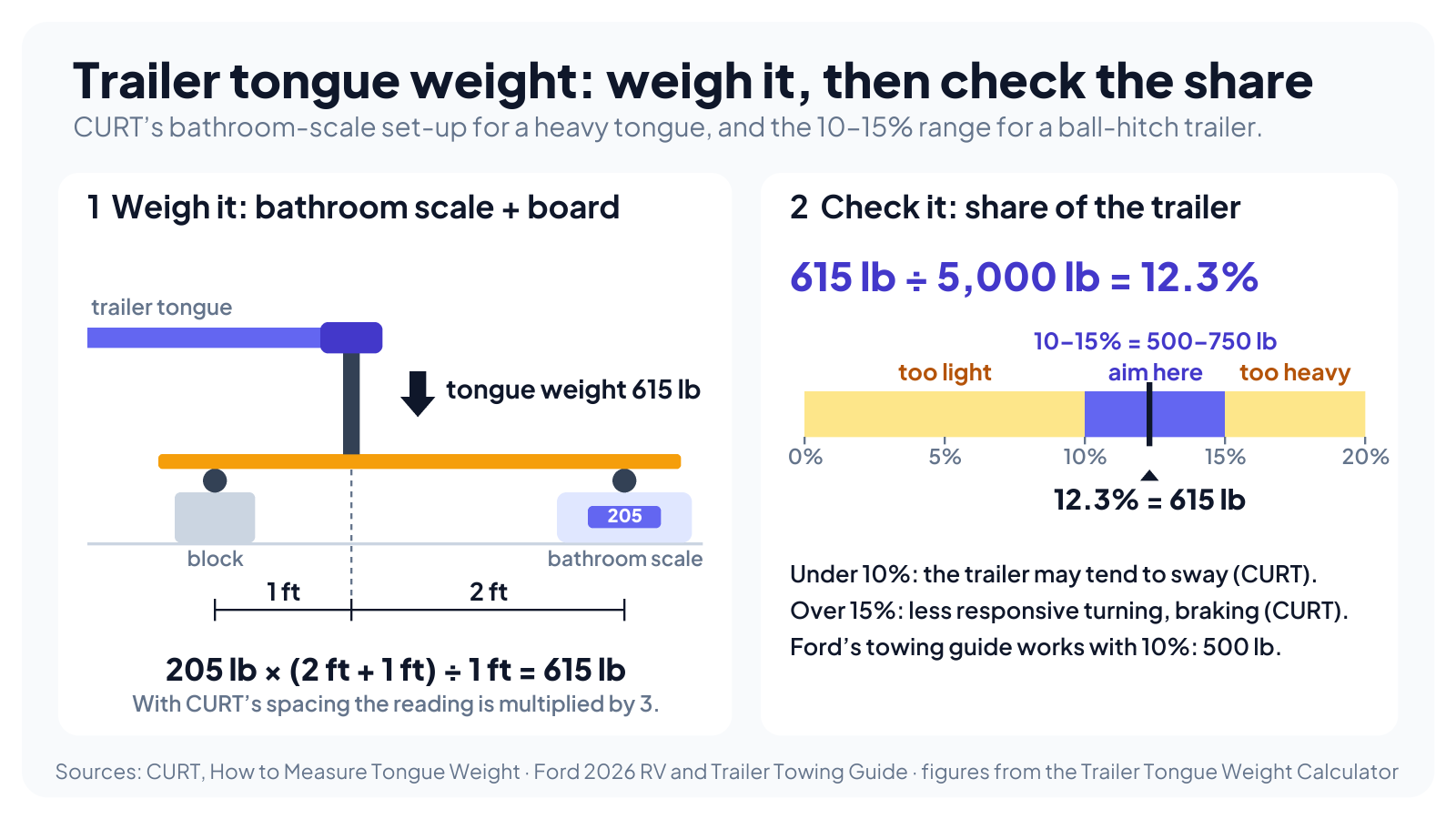
Bathroom scale + board: tongue weight = scale reading × (s + b) ÷ b, where s and b are the distances from the tongue to the scale pipe and to the block pipe
Vehicle scale: tongue weight = vehicle with the trailer hitched − vehicle alone
The sources differ on the exact figure, so the table sets them side by side. The calculator checks a ball-hitch trailer against CURT’s 10–15% and a 5th wheel or gooseneck against GM’s 15–30%, and shows Ford’s figure next to both.
| Source | Ball-hitch (conventional) trailer | 5th wheel or gooseneck |
|---|---|---|
| CURT, How to Measure Tongue Weight | About 10–15% of the gross trailer weight | Not covered |
| Ford 2026 RV and Trailer Towing Guide | 10% for trailers over 2,000 lb; no more than 200 lb for trailers up to 2,000 lb | 15% king pin weight |
| GM bulletin PIT5432B | Not covered | 15% to 30% of total trailer weight |
Tongue Weight Chart by Trailer Weight
The range grows with the trailer: every 1,000 lb of loaded trailer adds 100–150 lb to a ball-hitch trailer’s target. A 7,000 lb trailer should carry 700–1,050 lb on the tongue.
| Loaded trailer | Target, 10–15% | In kg | Ford’s figure |
|---|---|---|---|
| 1,500 lb | 150–225 lb | 68–102 kg | ≤ 200 lb |
| 2,000 lb | 200–300 lb | 90.7–136 kg | ≤ 200 lb |
| 3,000 lb | 300–450 lb | 136–204 kg | 300 lb |
| 3,500 lb | 350–525 lb | 159–238 kg | 350 lb |
| 5,000 lb | 500–750 lb | 227–340 kg | 500 lb |
| 6,000 lb | 600–900 lb | 272–408 kg | 600 lb |
| 7,000 lb | 700–1,050 lb | 318–476 kg | 700 lb |
| 8,000 lb | 800–1,200 lb | 363–544 kg | 800 lb |
| 10,000 lb | 1,000–1,500 lb | 454–680 kg | 1,000 lb |
“A 5th-wheel hitch is mounted in the pickup bed to put more of the trailer weight directly over the towing vehicle,” in Ford’s words, so its share is higher. GM’s range and Ford’s 15% give these figures:
| Loaded 5th wheel or gooseneck | Target, 15–30% | In kg | Ford’s figure (15%) |
|---|---|---|---|
| 8,000 lb | 1,200–2,400 lb | 544–1,089 kg | 1,200 lb |
| 10,000 lb | 1,500–3,000 lb | 680–1,361 kg | 1,500 lb |
| 11,500 lb | 1,725–3,450 lb | 782–1,565 kg | 1,725 lb |
| 14,000 lb | 2,100–4,200 lb | 953–1,905 kg | 2,100 lb |
| 16,000 lb | 2,400–4,800 lb | 1,089–2,177 kg | 2,400 lb |
How to Measure Tongue Weight: 3 Methods
CURT’s guide to measuring tongue weight gives three methods, depending on the equipment you have. Load the trailer the way you will tow it and park on level ground first.
- Tongue weight scale
Put the scale under the trailer jack and take the reading. If the jack does not fit on it, stand a sturdy pipe upright between the coupler and the scale.
- Bathroom scale, directly or with a board
A tongue under 300 lb can rest straight on a bathroom scale. Above that, lay a board on two horizontal pipes, one on the scale 2 ft from the tongue and one on a block 1 ft from it, rest the coupler on an upright pipe standing on the board, and multiply the reading by 3.
- Vehicle scale
Weigh the vehicle alone, then with the trailer hitched and the trailer’s wheels off the scale. The difference is the tongue weight. Unhook any weight-distribution bars first: Ford describes them as spreading tongue load to all the vehicle’s and trailer’s wheels, so tensioned bars make the difference read low.
The 3 comes from the balance of moments. With the coupler 1 ft from the block pipe and 2 ft from the scale pipe, the scale carries a third of the load, so the tongue weight is 3 times the reading. For any other spacing, multiply the reading by (s + b) ÷ b: a 150 lb reading with the pipes 3 ft and 1.5 ft from the tongue gives 150 × (3 + 1.5) ÷ 1.5 = 450 lb. If the board and pipes already show a reading before the coupler goes on, subtract it first.
How to Use the Trailer Tongue Weight Calculator
- Pick the trailer type
Choose Ball hitch for a bumper-pull trailer, or 5th wheel / gooseneck for a trailer that couples in the pickup bed.
- Enter the loaded trailer weight
Type the weight of the trailer with everything in it, in pounds or kilograms. The range to aim for shows straight away.
- Pick how you weighed the tongue
Choose Scale reading, Scale + board or Vehicle scale, and type the numbers that method asks for. The board’s distances start at CURT’s 2 ft and 1 ft.
- Read the check
The big number is the tongue weight’s share of the trailer. The check below it says whether that is in the range and how much weight to add or take off.
- Add your limits if you have them
Open Hitch rating, payload and moving the load to compare the tongue weight with your hitch rating and payload, and to see how far to move cargo.
Getting a car home that cannot ride on your own trailer? The towing cost estimator prices a tow truck by distance.
Worked Examples: Bathroom Scale, Truck Scale and a Load Shift
- Bathroom scale and board, 5,000 lb travel trailer
With CURT’s set-up the scale reads 205 lb, so the tongue weight is 205 × 3 = 615 lb. 615 ÷ 5,000 = 12.3%, inside the 10–15% range of 500–750 lb.
- Truck scale, the same trailer
The truck weighs 7,200 lb alone and 7,820 lb with the trailer hitched, so the tongue weight is 7,820 − 7,200 = 620 lb, or 12.4%.
- Too light: 350 lb on a 5,000 lb trailer
350 ÷ 5,000 = 7%, under the range and 150 lb short of 10%. With 14 ft from the hitch ball to the axle, moving 200 lb of cargo 10.5 ft forward adds the 150 lb; a 100 lb item would have to move 21 ft.
- 5th wheel on a truck scale: 11,500 lb trailer
The truck weighs 7,400 lb alone and 9,150 lb hitched, so the king pin weight is 1,750 lb, or 15.2%. That is inside GM’s 15–30% range of 1,725–3,450 lb and just above Ford’s 15% figure of 1,725 lb.
- Payload: 615 lb of tongue weight, 1,700 lb of payload
With 600 lb of people and cargo in the truck, 1,700 − 600 − 615 = 485 lb of payload is left. The same 615 lb is 82% of a 750 lb hitch rating.
How to Fix Tongue Weight That Is Too Light or Too Heavy
Move cargo inside the trailer. Ford’s 2026 RV and Trailer Towing Guide says to shift the load forward when the tongue weight is under the lower limit, and to move more of the trailer’s contents rearward when it is over the upper limit. It also puts about 60% of the cargo in the front half of the trailer and 40% in the rear, within the tongue weight limits.
Distance to move = weight needed × L ÷ cargo weight
The trailer rests on two supports, the hitch and the axle, so moving weight toward one of them puts more of it on that support. On a tandem, measure L to the point midway between the two axles. With L = 14 ft, every 100 lb moved 1 ft toward the hitch adds about 7 lb to the tongue.