Quick Answer
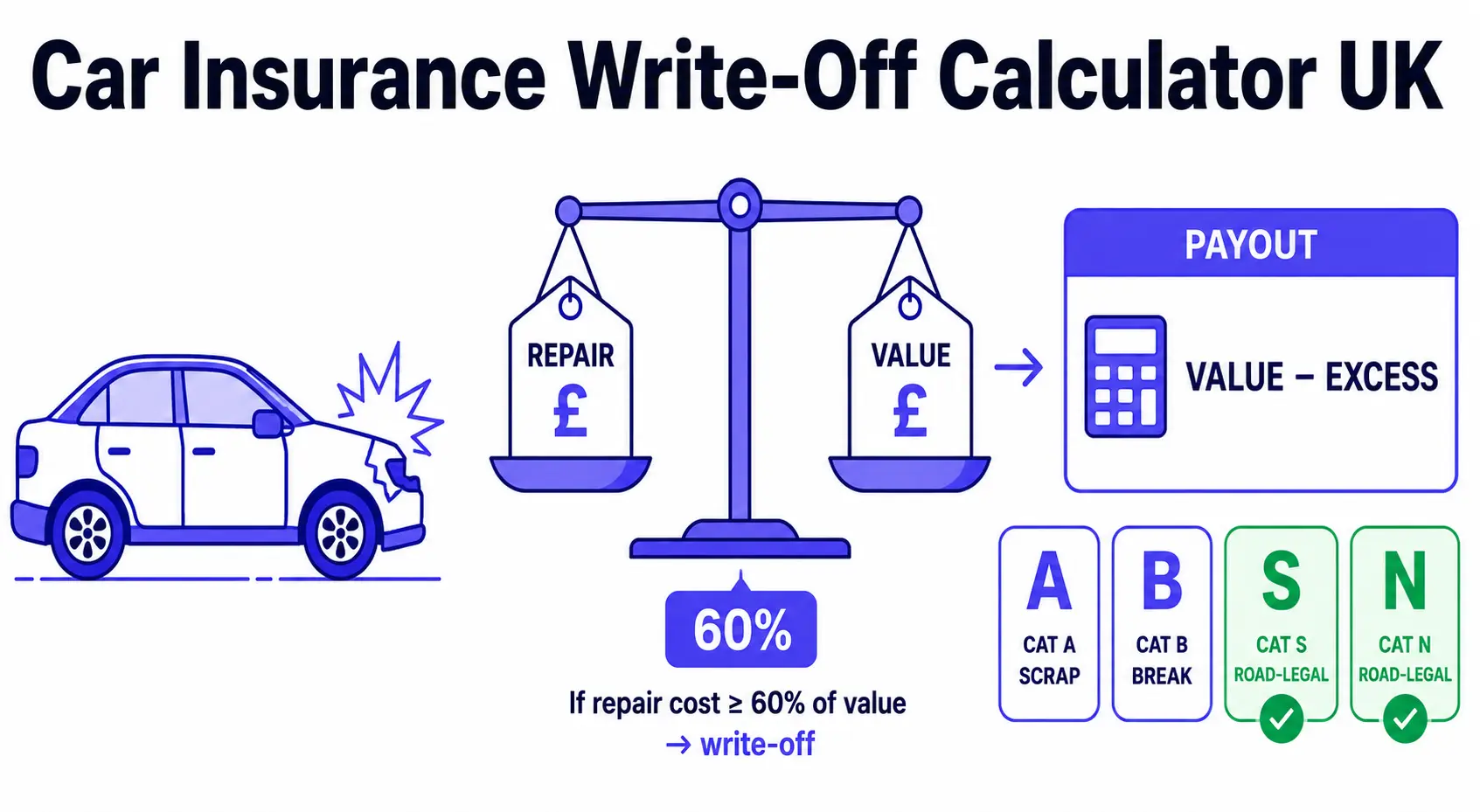
A UK car is usually written off when the repair bill passes about 50–70% of its market value — most insurers use around 60%. If it is declared a total loss, the payout is the car's market value minus your excess (for example £6,000 − £250 = £5,750), not what you paid. This car insurance write-off calculator works out the repair-to-value ratio and your likely payout.
How the Car Insurance Write-Off Calculator Works
A car is a write-off (total loss) when it is unsafe to repair or simply not worth it. For the money side, insurers compare the repair bill with the car’s value: this car insurance write-off calculator divides the two to get a repair-to-value ratio, then checks it against your insurer’s threshold. There is no legal percentage — most UK insurers write a car off somewhere between 50% and 70% of market value, with 60% a common middle point.
Payout: settlement = market value − excess (− any retained salvage), with finance paid to the lender first.
| Repair vs market value | Likely outcome |
|---|---|
| Below about 50% | Almost always repaired |
| 50%–70% (grey zone) | Depends on the insurer, the car’s age and the extra costs |
| Above about 70% | Almost always written off |
UK Write-Off Categories: Cat A, B, S and N
If a car is written off, the insurer assigns a salvage category under the Association of British Insurers code. The category depends on the type of damage, not the ratio above — and it decides whether the car can ever go back on the road.
| Category | Damage | Back on the road? |
|---|---|---|
| Cat A | Most severe — scrap only | No. Whole car crushed, not even parts reused |
| Cat B | Body shell destroyed | No, but some parts may be salvaged |
| Cat S | Structural damage (chassis, crumple zone), repairable | Yes, if professionally repaired and re-registered |
| Cat N | Non-structural (cosmetic, electrical, brakes), repairable | Yes, after repair |
How to Use the Car Insurance Write-Off Calculator
-
Enter the car’s market value
Use the pre-accident value — what it would have sold for the day before, not what you paid. Compare similar cars on Auto Trader for a realistic figure. If the insurer’s figure looks low, the Financial Ombudsman’s guidance on vehicle valuations sets out what a fair market value should reflect.
-
Will it be written off? Add the repair cost and threshold
Type the estimated repair bill and your insurer’s threshold (60% is a safe default). The tool shows the ratio and a repairable / borderline / write-off verdict.
-
Payout estimate: add your excess and finance
Switch mode, then enter your policy excess and any outstanding finance. If you want to keep a Cat S or N car, add its salvage value to see your reduced payout.
-
Read the result
Mode A gives the verdict and how far you are over or under the write-off point; Mode B gives the settlement you would receive. Share a link to reload your figures.
Worked Examples: Write-Off Check & Payout
Every figure below is exactly what the calculator prints — enter the same inputs to check.
Will it be written off? (threshold 60%)
| Market value | Repair cost | Ratio | Verdict |
|---|---|---|---|
| £10,000 | £4,000 | 40% | Likely repairable |
| £3,000 | £1,650 | 55% | Borderline |
| £2,000 | £1,200 | 60% | Likely write-off |
| £6,000 | £4,200 | 70% | Likely write-off |
How much will I get? (payout)
| Value | Excess | Finance / salvage | You receive |
|---|---|---|---|
| £6,000 | £250 | — | £5,750 |
| £8,000 | £500 | — | £7,500 |
| £4,000 | £250 | Keep car, £800 salvage | £2,950 (+ keep car) |
| £5,000 | £250 | £6,000 finance | £0 (£1,250 short — GAP) |