

Quick Answer
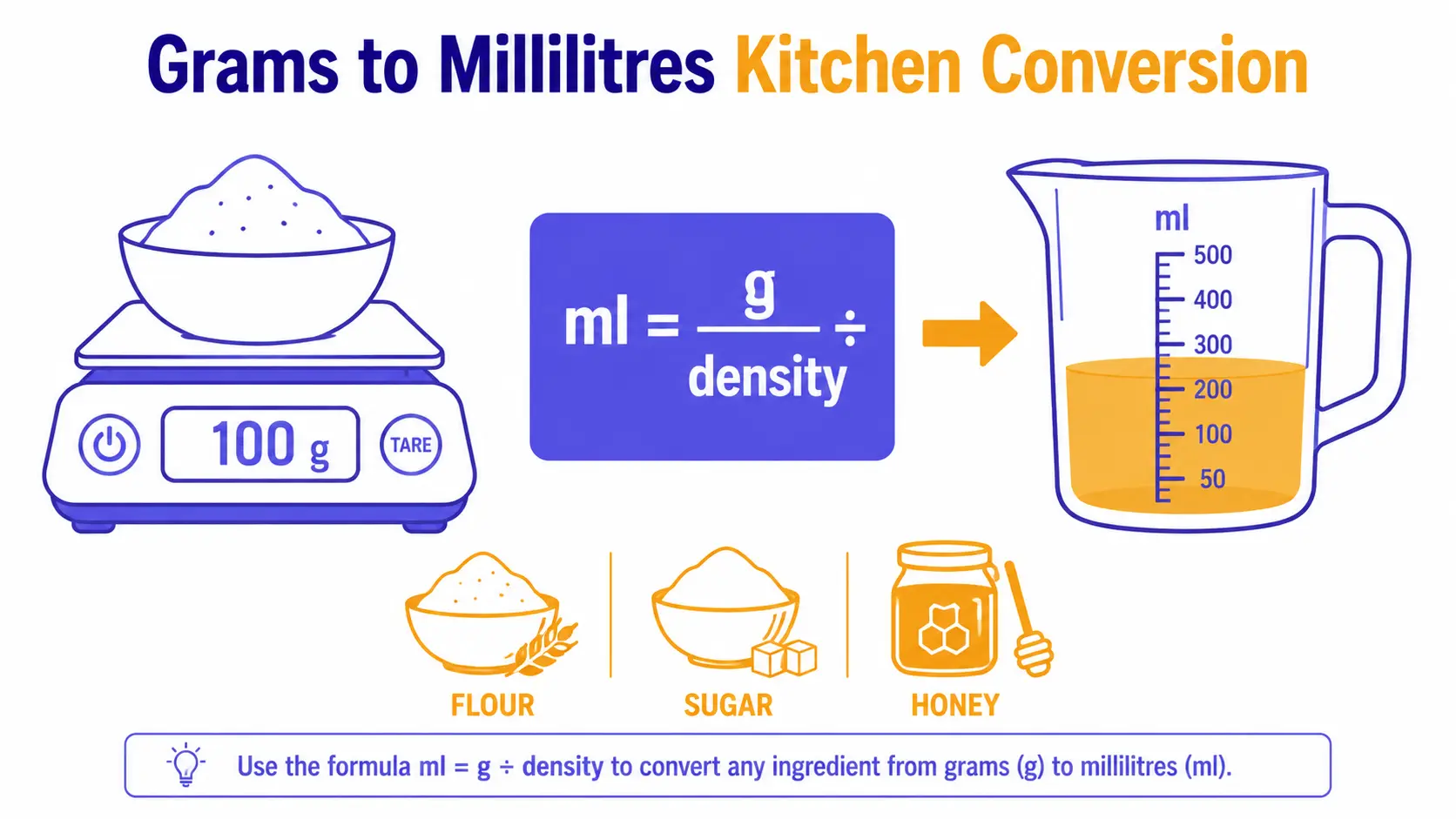
To convert grams to millilitres, divide the weight by the ingredient's density: ml = grams ÷ density (g/ml). Water has a density of 1 g/ml so 100 g = 100 ml, but 100 g of flour (0.53 g/ml) is about 189 ml and 100 g of honey (1.42 g/ml) is only about 70 ml — which is why this converter asks you to pick the ingredient.
Grams to mL Formula
Grams measure how heavy something is; millilitres measure how much space it takes up. Neither one can be turned into the other without a third number: the ingredient’s density, the mass of exactly one millilitre, written in grams per millilitre (g/ml). Water sits at the reference point of 1 g/ml, which is why 1 gram of water is 1 ml. Every other ingredient is lighter or heavier per millilitre, so this grams to ml converter asks which ingredient you are measuring before it does anything else.
where density is in g/ml. So 100 g of flour ÷ 0.53 g/ml = 188.68 ml, while 100 g of honey ÷ 1.42 g/ml = 70.42 ml. The same 100 grams fills 2.68 times more of a jug as flour than as honey.
That single division is the whole method, and it scales far beyond the kitchen — converting a mass flow rate into a volume flow rate with our lb/hr to GPM calculator uses exactly the same density step, just with pounds and gallons instead of grams and millilitres.
Density Chart for All 17 Ingredients
These are the densities the converter loads when you pick an ingredient. The last two columns are the two conversions people actually search for — what 100 grams comes to, and what a single gram comes to.
| Ingredient | Density (g/ml) | 100 g → | 1 g → |
|---|---|---|---|
| Water | 1.00 | 100 ml | 1 ml |
| Milk | 1.03 | 97.09 ml | 0.9709 ml |
| Flour (all-purpose) | 0.53 | 188.68 ml | 1.89 ml |
| Sugar (granulated) | 0.85 | 117.65 ml | 1.18 ml |
| Salt (table) | 1.22 | 81.97 ml | 0.8197 ml |
| Honey | 1.42 | 70.42 ml | 0.7042 ml |
| Butter | 0.911 | 109.77 ml | 1.1 ml |
| Oil | 0.92 | 108.7 ml | 1.09 ml |
| Nuts and seeds | 0.55 | 181.82 ml | 1.82 ml |
| Cacao (cocoa powder) | 0.365 | 273.97 ml | 2.74 ml |
| Rice (raw) | 0.85 | 117.65 ml | 1.18 ml |
| Oats (rolled) | 0.34 | 294.12 ml | 2.94 ml |
| Jam | 1.33 | 75.19 ml | 0.7519 ml |
| Nutella | 1.26 | 79.37 ml | 0.7937 ml |
| Maple syrup | 1.33 | 75.19 ml | 0.7519 ml |
| Cream 38% fat | 0.99 | 101.01 ml | 1.01 ml |
| Cream 13% fat | 1.01 | 99.01 ml | 0.9901 ml |
The spread is wider than most people expect. Oats at 0.34 g/ml and honey at 1.42 g/ml sit at the two ends: 100 g of oats fills 294.12 ml, 100 g of honey fills 70.42 ml, so the same weight occupies 4.18 times more space as oats. Any rule of thumb that treats grams and millilitres as interchangeable fails badly on both.
How to Convert Grams to mL
- Pick your ingredient
Choose from the list — water, milk, flour, sugar, salt, honey, butter, oil and nine more. The tool loads that ingredient’s density for you. If yours is not there, choose Other (enter density) and type the density in g/ml.
- Enter the amount and choose the unit
Type how much you have, then pick the unit next to the box. Choosing grams converts to millilitres; choosing millilitres converts to grams. One screen, both directions — you do not need a second tool for the reverse.
- Read the result
The headline card gives the converted amount. Under it are the density used and the kitchen equivalents — teaspoons, tablespoons and US cups — plus the worked line of maths, so you can see the exact division or multiplication that produced the answer.
Working Out a Density That Is Not in the List
Seventeen presets cover most of a kitchen, but not a specific brand of tahini or a syrup made to your own recipe. The Other (enter density) option exists for those, and the density it wants is a number you can obtain in about a minute.
- Look at the label first
Many products already state it, though rarely under that name. A label reading 100 ml = 74 g is telling you the density is 0.74 g/ml; one reading 250 g per 200 ml means 250 ÷ 200 = 1.25 g/ml. Any pair of a weight and a volume for the same product gives you the number.
- Otherwise weigh 100 ml of it
Put a measuring jug on the scale, zero the scale with the empty jug on it, then fill to exactly 100 ml and read the grams. Divide that reading by 100 and you have the density in g/ml — 74 g becomes 0.74 g/ml. Use 100 ml rather than a spoonful; a small volume magnifies every error in the reading.
- Type it into the tool
Choose Other (enter density) in the ingredient list, enter your g/ml value in the density box that appears, then carry on as normal. The converter uses your number in place of a preset and shows it back to you in the density read-out, so you can confirm it took the right one.
Common Gram Amounts in Millilitres
Recipes rarely ask for a round 100 g, so this table runs the amounts people search for most through the six most-used ingredients. Every cell is the tool’s own output, in millilitres.
| Weight | Water | Flour | Sugar | Milk | Oil | Honey |
|---|---|---|---|---|---|---|
| 10 g | 10 | 18.87 | 11.76 | 9.71 | 10.87 | 7.04 |
| 17 g | 17 | 32.08 | 20 | 16.5 | 18.48 | 11.97 |
| 50 g | 50 | 94.34 | 58.82 | 48.54 | 54.35 | 35.21 |
| 100 g | 100 | 188.68 | 117.65 | 97.09 | 108.7 | 70.42 |
| 150 g | 150 | 283.02 | 176.47 | 145.63 | 163.04 | 105.63 |
| 175 g | 175 | 330.19 | 205.88 | 169.9 | 190.22 | 123.24 |
| 200 g | 200 | 377.36 | 235.29 | 194.17 | 217.39 | 140.85 |
| 250 g | 250 | 471.7 | 294.12 | 242.72 | 271.74 | 176.06 |
| 500 g | 500 | 943.4 | 588.24 | 485.44 | 543.48 | 352.11 |
Read the water column and the honey column side by side and the point of the whole exercise appears: 500 g is 500 ml of water but only 352.11 ml of honey, a gap of nearly 150 ml on a single measurement.
Flour, Milk and Sugar in Detail
Flour is the one that catches people out, because it is the lightest common baking ingredient at 0.53 g/ml. 100 g of flour is 188.68 ml — almost double what the weight suggests — and 175 g comes to 330.19 ml. If a recipe gives flour by weight and you only have a jug, this is the conversion that decides whether the dough works. It is also why bakers state hydration by weight rather than volume; our sourdough hydration calculator works entirely in grams for the same reason.
Milk is close to water but not equal to it. At 1.03 g/ml, 100 g of milk is 97.09 ml and 200 ml of milk weighs 206 g. The 3% gap is small enough to ignore in a soup and large enough to matter in a custard or a bread dough measured to the gram.
Sugar at 0.85 g/ml is lighter than water but much heavier than flour: 100 g is 117.65 ml, and 150 g is 176.47 ml. Granulated sugar packs more consistently than flour, which is why volume measures go wrong less often with sugar — but they still go wrong.
Converting Millilitres Back to Grams
The same density runs in reverse: multiply instead of divide. Switch the unit picker to millilitres and the tool answers in grams. This is the direction you need when a recipe is written in millilitres and your scale is the only thing on the counter.
| Volume | Water | Flour | Sugar | Milk | Oil | Honey |
|---|---|---|---|---|---|---|
| 5 ml (1 tsp) | 5 | 2.65 | 4.25 | 5.15 | 4.6 | 7.1 |
| 15 ml (1 tbsp) | 15 | 7.95 | 12.75 | 15.45 | 13.8 | 21.3 |
| 60 ml | 60 | 31.8 | 51 | 61.8 | 55.2 | 85.2 |
| 100 ml | 100 | 53 | 85 | 103 | 92 | 142 |
| 200 ml | 200 | 106 | 170 | 206 | 184 | 284 |
| 250 ml | 250 | 132.5 | 212.5 | 257.5 | 230 | 355 |
| 500 ml | 500 | 265 | 425 | 515 | 460 | 710 |
All figures are in grams. Note how 60 ml swings from 31.8 g of flour to 85.2 g of honey — the answer to how many grams is 60 ml is genuinely different for every ingredient, which is why no single number can be given.
Millilitres Are Not Millimetres
The related mix-up is treating grams and millilitres as the same unit with two names. They are not: one is mass, the other is volume, and they only line up for water and for the handful of ingredients that happen to sit near 1 g/ml — milk at 1.03, cream at 0.99 and 1.01. For everything else the two numbers separate immediately. If you need the volume of a container rather than the volume of its contents, that is a geometry problem instead, and our volume calculator handles it across ten shapes.
Why a Scale Beats a Measuring Cup
Assume 1 g = 1 ml for flour and you end up 47% short of the volume the recipe wanted; make the same assumption for honey and you are 42% over. Those are not rounding errors, they are failed recipes. The table below shows what 100 g of each ingredient becomes in the spoon and cup measures the tool reports alongside every answer.
| 100 g of | Millilitres | Teaspoons | Tablespoons | US cups |
|---|---|---|---|---|
| Water | 100 | 20.29 | 6.76 | 0.4227 |
| Flour | 188.68 | 38.28 | 12.76 | 0.7975 |
| Sugar | 117.65 | 23.87 | 7.96 | 0.4973 |
| Milk | 97.09 | 19.7 | 6.57 | 0.4104 |
| Oil | 108.7 | 22.05 | 7.35 | 0.4594 |
| Honey | 70.42 | 14.29 | 4.76 | 0.2977 |
| Butter | 109.77 | 22.27 | 7.42 | 0.464 |
| Oats | 294.12 | 59.67 | 19.89 | 1.24 |
The spoon and cup figures use the exact US definitions published by NIST Special Publication 811, Appendix B.8: one teaspoon is 4.92892159 ml, one tablespoon is 14.7867648 ml and one US cup is 236.5882365 ml. A cup of oats and a cup of honey are the same 236.5882365 ml of space and nowhere near the same weight — 80.44 g against 335.96 g — which is the entire argument for owning a scale.