Quick Answer
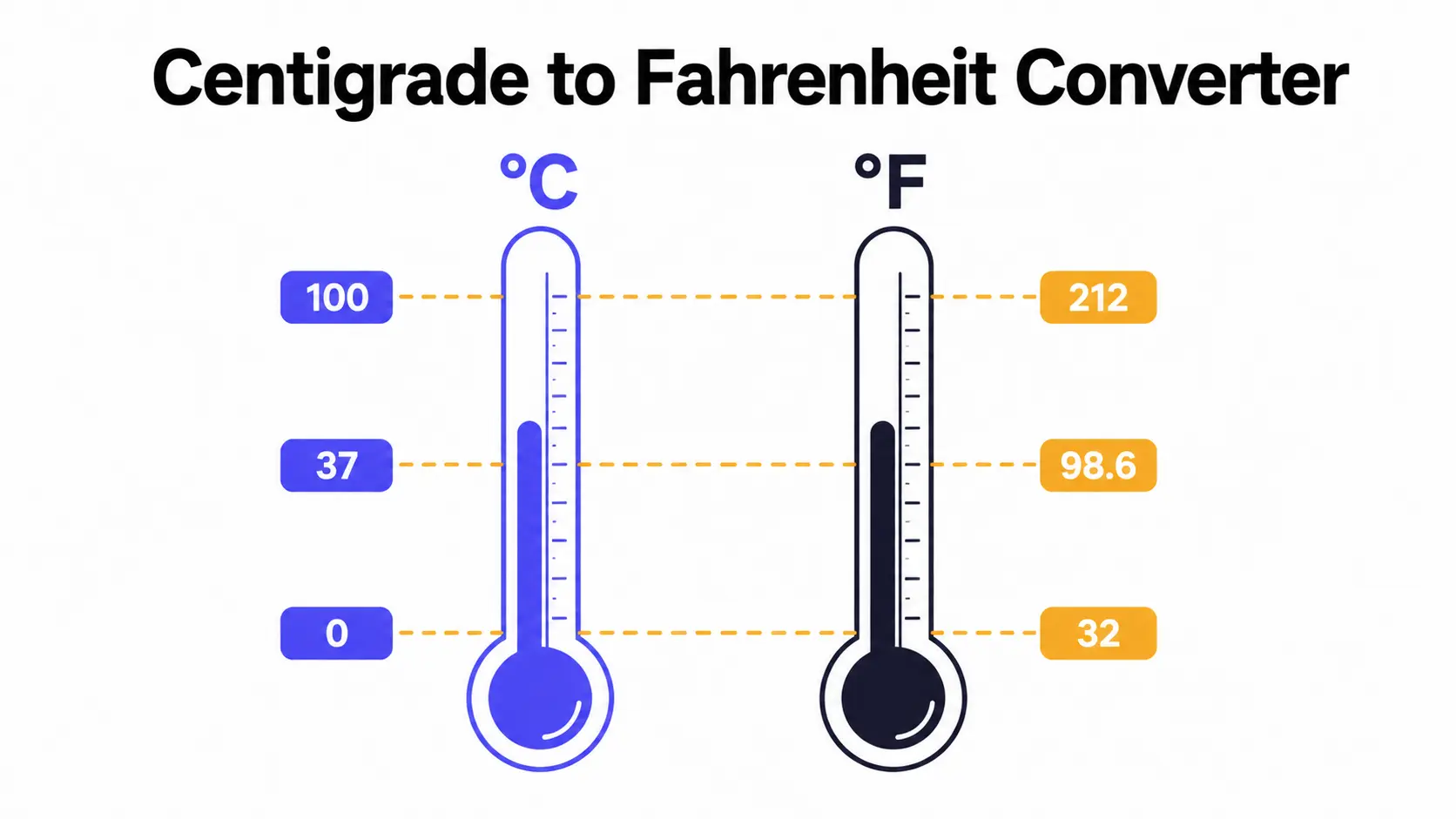
To convert centigrade into Fahrenheit, multiply by 9/5 (1.8) and add 32: °F = (°C × 1.8) + 32. So 25 °C is 77 °F, 37 °C is 98.6 °F and 100 °C is 212 °F. Centigrade and Celsius are the same scale — "degree Celsius" simply became the official name in 1948.
Centigrade to Fahrenheit Formula
Two numbers do all the work. Fahrenheit degrees are smaller than centigrade degrees — NIST puts it as one centigrade degree equalling an interval of 1.8 Fahrenheit degrees — and the Fahrenheit scale starts 32 degrees lower. So to convert centigrade into Fahrenheit you stretch the number by 1.8, then shift it up by 32.
°C = (°F − 32) × 5/9 — Fahrenheit back to centigrade
K = °C + 273.15 — centigrade to kelvin
Working 25 °C through it: 25 × 1.8 = 45, then 45 + 32 = 77 °F. Going the other way, 77 °F − 32 = 45, then 45 × 5/9 = 25 °C. The calculator above does both directions live — type in either box.
Centigrade vs Celsius: Is There a Difference?
No — they are the same scale, and the same degree. “Centigrade” means “a hundred steps”, describing the 100 degrees between water freezing and water boiling. The name changed for a practical reason: grade and centigrade were already used as angle units in some countries, so the measurement world needed something unambiguous.
The General Conference on Weights and Measures settled it in 1948: Resolution 7 of the 9th CGPM lists the unit as degree Celsius with the symbol °C — named after the Swedish astronomer Anders Celsius. Older textbooks, recipes and thermometers still say centigrade, and they mean exactly the same thing. Any centigrade to Fahrenheit conversion is a Celsius to Fahrenheit conversion.
| Scale | Water freezes | Water boils | Absolute zero |
|---|---|---|---|
| Centigrade / Celsius (°C) | 0 °C | 100 °C | −273.15 °C |
| Fahrenheit (°F) | 32 °F | 212 °F | −459.67 °F |
| Kelvin (K) | 273.15 K | 373.15 K | 0 K |
Centigrade to Fahrenheit Chart
Everyday temperatures, converted exactly. Nothing here is rounded.
| Centigrade | Fahrenheit | What it means |
|---|---|---|
| −20 °C | −4 °F | Severe winter |
| −10 °C | 14 °F | Hard frost |
| 0 °C | 32 °F | Water freezes |
| 5 °C | 41 °F | Cold |
| 10 °C | 50 °F | Cool |
| 15 °C | 59 °F | Mild |
| 20 °C | 68 °F | Room temperature |
| 25 °C | 77 °F | Warm summer day |
| 30 °C | 86 °F | Hot |
| 35 °C | 95 °F | Very hot |
| 37 °C | 98.6 °F | Body temperature |
| 40 °C | 104 °F | Heatwave / high fever |
| 100 °C | 212 °F | Water boils |
Oven temperatures, which is where most centigrade to Fahrenheit conversions actually happen:
| Oven setting | Exact Fahrenheit | Dial setting |
|---|---|---|
| 120 °C | 248 °F | 250 °F |
| 140 °C | 284 °F | 285 °F |
| 160 °C | 320 °F | 320 °F |
| 170 °C | 338 °F | 340 °F |
| 180 °C | 356 °F | 355 °F |
| 190 °C | 374 °F | 375 °F |
| 200 °C | 392 °F | 390 °F |
| 220 °C | 428 °F | 430 °F |
| 240 °C | 464 °F | 465 °F |
Following an American recipe usually means converting more than the oven dial — our Grams to mL Converter handles the ingredient side, and the rest of the conversion calculators cover weight, length and volume.
How to Use the Centigrade to Fahrenheit Converter
-
Type your centigrade value in the left box
The Fahrenheit box fills in as you type. Decimals and negative numbers both work — try −40 and watch both boxes match.
-
Or type Fahrenheit in the right box instead
It works the same in reverse. There is no swap button to press and nothing to submit; whichever box you type in, the other one follows.
-
Read the working underneath
The result panel shows your own numbers put through the formula, plus the kelvin value and the temperature rounded to the nearest whole degree.
How to Convert Centigrade to Fahrenheit in Your Head
The popular shortcut is double it and add 30. It is quick and it is good enough for weather — but it is worth knowing exactly where it drifts, because most sites that repeat it never say.
The shortcut is perfect at 10 °C (both give 50 °F), and from there the error grows by about 1 °F for every 5 °C you move away. At 20 °C it is 2 °F out, at 30 °C it is 4 °F out, and at body temperature it is 5.4 °F out — enough to turn a fever into a panic.
| Centigrade | Shortcut (×2 + 30) | Exact | Error |
|---|---|---|---|
| 0 °C | 30 °F | 32 °F | 2 °F |
| 10 °C | 50 °F | 50 °F | 0 °F |
| 20 °C | 70 °F | 68 °F | 2 °F |
| 25 °C | 80 °F | 77 °F | 3 °F |
| 30 °C | 90 °F | 86 °F | 4 °F |
| 37 °C | 104 °F | 98.6 °F | 5.4 °F |
| 40 °C | 110 °F | 104 °F | 6 °F |
A better head trick: double the centigrade, take off a tenth of that, then add 32. For 25 °C: double to 50, take off 5 to get 45, add 32 → 77 °F. That is not an approximation — it is the exact answer, because subtracting a tenth of double turns ×2 into ×1.8.
Worked Examples: Centigrade to Fahrenheit
Every figure below is exactly what the converter prints.
| Conversion | Step 1: × 1.8 | Step 2: + 32 | Answer |
|---|---|---|---|
| 25 °C to °F | 45 | 45 + 32 | 77 °F |
| 37 °C to °F | 66.6 | 66.6 + 32 | 98.6 °F |
| 180 °C to °F | 324 | 324 + 32 | 356 °F |
| 100 °C to °F | 180 | 180 + 32 | 212 °F |
| 0 °C to °F | 0 | 0 + 32 | 32 °F |
| −40 °C to °F | −72 | −72 + 32 | −40 °F |
| −273.15 °C to °F | −491.67 | −491.67 + 32 | −459.67 °F |