

Quick Answer
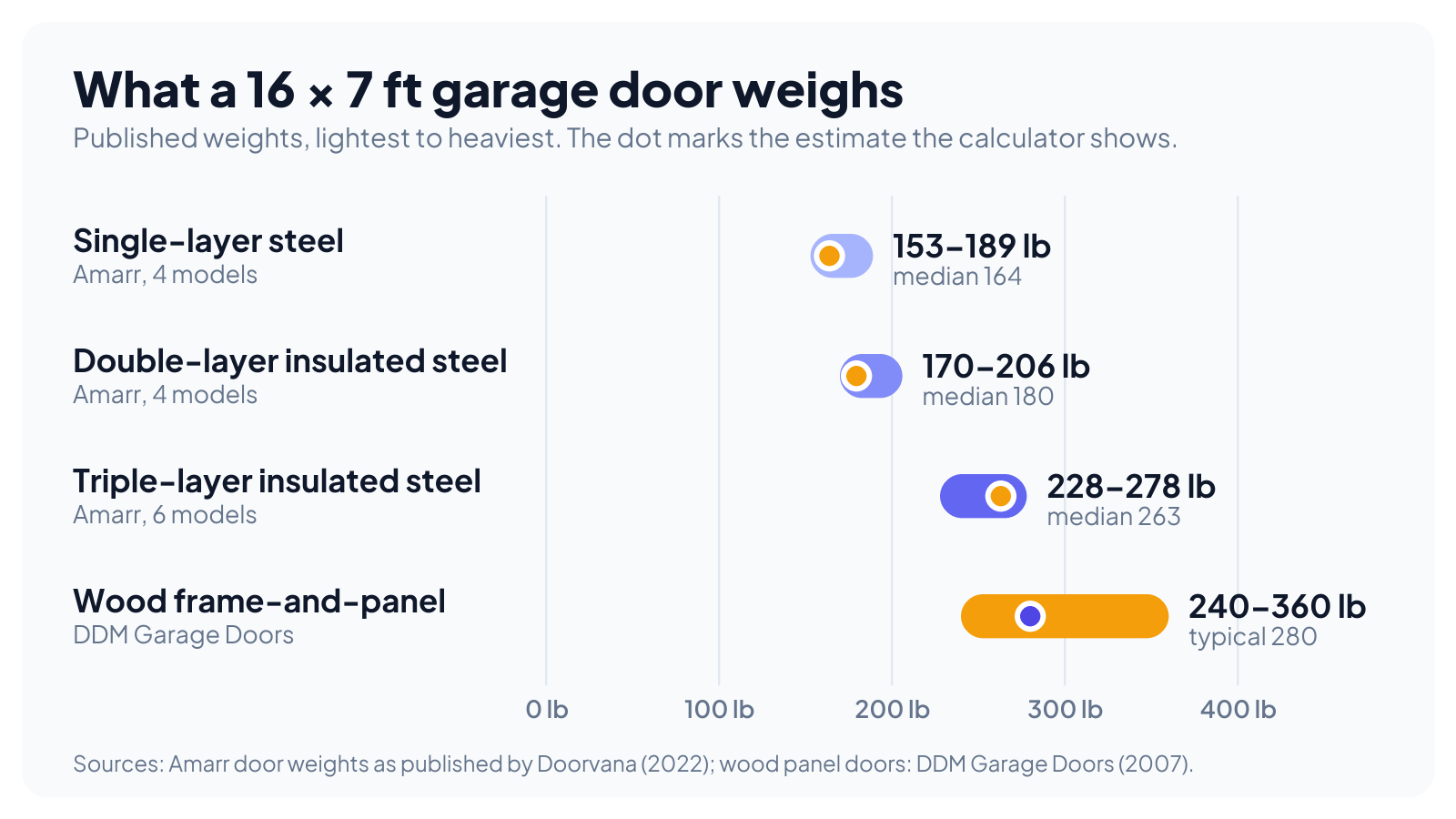
This garage door weight calculator multiplies the door's area by its weight per square foot. Amarr publishes 153–189 lb for a 16 × 7 ft single-layer steel door, 170–206 lb double-layer and 228–278 lb triple-layer insulated, while a 16 × 7 wood panel door runs 240–360 lb.
Garage Door Weight Formula: Area × Pounds per Square Foot
A sectional garage door’s weight grows with its area, and each square foot weighs more as the construction gets heavier. The calculator multiplies the width by the height, applies the weight per square foot of your door’s construction, and adds any windows.
Steel doors = Amarr’s published weight for each model, read at your size, then the median model
Kilograms = pounds × 0.4536
Use the table to find your construction. Look at the inside face of the door: the layers you can see decide the weight per square foot.
| Construction | How to spot it | Pounds per sq ft | 16 × 7 ft door |
|---|---|---|---|
| Single-layer steel | Bare painted steel on the inside | 1.37–1.90 | 153–189 lb |
| Double-layer insulated steel | Foam with a vinyl or paper backing | 1.52–2.06 | 170–206 lb |
| Triple-layer insulated steel | Steel on both faces, foam between | 2.02–2.71 | 228–278 lb |
| Wood frame-and-panel | Wood stiles and rails with inset panels | 2.14–3.21 | 240–360 lb |
Garage Door Weight Chart by Size (Amarr’s Published Weights)
Amarr lists the weight of every size of its Lincoln, Heritage, Designers Choice, Classica and Hillcrest steel doors, as reproduced in Doorvana’s garage door springs and weight chart. Each cell is the lightest to the heaviest model of that construction, without windows.
| Door size (width × height) | Single-layer steel | Double-layer insulated | Triple-layer insulated |
|---|---|---|---|
| 8 × 7 ft | 83–93 lb | 91–102 lb | 123–143 lb |
| 8 × 8 ft | 98–109 lb | 107–119 lb | 145–165 lb |
| 9 × 7 ft | 91–102 lb | 100–112 lb | 136–159 lb |
| 9 × 8 ft | 107–119 lb | 117–130 lb | 159–183 lb |
| 10 × 7 ft | 103–115 lb | 112–126 lb | 150–177 lb |
| 10 × 8 ft | 119–135 lb | 131–147 lb | 177–204 lb |
| 16 × 7 ft | 153–189 lb | 170–206 lb | 228–278 lb |
| 16 × 8 ft | 179–207 lb | 199–226 lb | 267–311 lb |
| 18 × 7 ft | 206–240 lb | 224–259 lb | 254–341 lb |
| 18 × 8 ft | 247–271 lb | 268–296 lb | 297–390 lb |
The weight per square foot is not constant. Amarr’s single-layer Lincoln LI1000 weighs 1.37 lb per sq ft at 16 × 7 ft but 1.72 lb at 18 × 8 ft, so the calculator reads each model at your exact size instead of using one flat rate.
How to Use the Garage Door Weight Calculator
- Enter the width and height
Measure the door itself, not the opening. Type the size in feet, inches, meters or centimeters, or tap a common size such as 16 × 7.
- Pick the construction
Look at the inside face. Bare steel is single-layer, foam with a backing is double-layer, and steel on both faces is triple-layer.
- Add the windows
Count the panes of glass and pick the glass type. Leave the count at zero for a solid door.
- Read the estimate and the range
The big number is the median model at your size, and the range runs from the lightest to the heaviest. At a size Amarr publishes, the manufacturer check lists each series.
- Size the springs
Follow the link under the result to open the torsion spring calculator with your door’s weight already filled in.
Worked Examples: 16 × 7, 9 × 7 and 12 × 7 Garage Doors
- 16 × 7 ft single-layer steel door
Amarr publishes four single-layer weights at this size: 153, 153, 175 and 189 lb. The median of the four is 164 lb, about 74 kg, so the calculator shows ≈ 164 lb with a range of 153–189 lb.
- 9 × 7 ft double-layer door with four short insulated windows
The four published double-layer weights are 100, 100, 109 and 112 lb, a median of 104.5 lb. Four short insulated panes add 4 × 6 = 24 lb, so the result is ≈ 129 lb with a range of 124–136 lb.
- 12 × 7 ft single-layer door (between two published sizes)
12 ft is a third of the way from 10 ft to 16 ft, so each model’s weight per square foot is read a third of the way along. Amarr’s Lincoln LI1000 drops from 1.471 lb per sq ft at 10 × 7 to 1.366 at 16 × 7, giving 1.436 × 84 sq ft = 120.7 lb. Across the four models the calculator shows ≈ 128 lb with a range of 121–136 lb.
How to Weigh a Garage Door
A scale reading beats any estimate when you order springs. Doorvana’s field method takes a mechanical scale and, for a two-car door, two or three people.
- Disengage the opener
Pull the emergency release so the door moves freely by hand.
- Place the scale
Set a mechanical scale under the center of the bottom edge. On a two-car door, two people lift both sides while a third slides the scale in.
- Lower the door and read it
Let the door rest on the scale, note the weight, then lift it off and reconnect the opener.
Garage Door Weight and Spring Size
Torsion springs are sized from the door’s weight, its height and the cable drums. The Torsion Spring Calculator turns the weight into the spring strength (IPPT) each spring needs. In the same chart Amarr’s guideline is that most one-car doors 10 ft wide or less can use one torsion spring, and two-car doors 10 ft 3 in and wider use two.
Extension springs are sold by the door weight they lift, color-coded in 10 lb steps, and the colors repeat every 100 lb. A 160 lb door, for example, takes the 160 lb spring, which is painted brown.
| Spring color | Door weight (lb) |
|---|---|
| White | 10 · 110 · 210 |
| Green | 20 · 120 · 220 |
| Yellow | 30 · 130 · 230 |
| Blue | 40 · 140 · 240 |
| Red | 50 · 150 · 250 |
| Brown | 60 · 160 · 260 |
| Orange | 70 · 170 · 270 |
| Gold | 80 · 180 · 280 |
| Light blue | 90 · 190 · 290 |
| Tan | 100 · 200 · 300 |
Wood, Wood-Overlay and Full-View Glass Garage Door Weights
For these doors the sources behind this page give only whole-door weights, so the calculator shows the published figure for a one-car or two-car door instead of scaling by size.
| Door type | One-car door | Two-car door |
|---|---|---|
| Solid wood / carriage house | About 300 lb | Near 500 lb |
| Wood overlay on a steel base | Around 250 lb | 300–400 lb |
| Aluminum full-view glass | 300–400 lb | Over 500 lb |
These figures are from Garage Door Guide. Wood panel doors vary just as widely: DDM Garage Doors has replaced springs on 16 × 7 ft wood panel doors weighing 240–250 lb (newer, thin panels and narrow rails) and 350–360 lb (older, thick panels and wide rails).
Options add weight to any door. Insulated glass adds about 6 lb per short pane and 10–12 lb per long pane, decorative glass 15–20 lb per pane, and a reinforcing strut about 1 lb per foot of its length. Plain single- or double-strength glass adds almost nothing, because the glass weighs about what the cut-out removed.