
Quick Answer
Excavation cost = bank cubic yards × your quoted rate per yard. Bank yards are length × width × depth in feet ÷ 27. Soil then swells 5–67% once dug, so hauling is priced on loose yards, not bank yards. No authority publishes a residential rate per yard, so the rate must come from your contractor.
How to Use the Excavation Cost Calculator
- Measure the hole, not the structure. Excavators cut wider than the finished wall so crews have working room. Enter length, width and average depth — the unit pickers take feet, inches, yards, metres or centimetres.
- Pick the soil. This only sets a starting swell figure; it does not change the price. The swell box stays editable because the two published sources disagree.
- Set the truck size. Haul trucks are rated in loose cubic yards. A tandem carries roughly 10–12; a tri-axle 14–16. Ask your hauler what they are sending.
- Leave the rate blank if you have no quote. The calculator still returns bank yards, loose yards and truck loads — the three numbers you need before you can ask anyone for a price.
Every published excavation bid item is measured in place, so a contractor’s rate per yard is a bank yard. Swell changes how many trucks leave the site, not how much dirt you paid to dig.
The Formula
Four steps, in this order:
- Bank volume = length × width × depth (feet) ÷ 27 = cubic yards in place.
- Loose volume = bank yards × (1 + swell %). This is what fills the trucks.
- Truck loads = loose yards ÷ truck capacity, rounded up.
- Cost = bank yards × your quoted rate per yard.
Why No One Publishes a Price Per Cubic Yard
Search results are full of confident national averages. None of them traces back to a publisher. The nearest thing to an authoritative residential figure is the National Association of Home Builders’ Cost of Constructing a Home-2024 (published 20 January 2025), and its line item reads “Excavation, Foundation, Concrete, Retaining walls, and Backfill — $43,002 — 10.0%”. That bundles five trades into one lump sum per average home. It is not a rate you can multiply by cubic yards, and NAHB says the survey “is not designed to capture representative characteristics of the average home built during a particular year”.
What is published is public roadway contract data. State transportation departments post the unit prices contractors actually bid. Those are real numbers with real dates — but they describe highway work, not a basement.
| Published item | Unit price | Source & date |
|---|---|---|
| Excavation (Roadway) | $6.71 / CY | TxDOT statewide average low bid, page last updated 8 August 2024 |
| Excavation (Roadway and Channel) | $11.00 / CY | TxDOT, same table |
| Excavation (Special) | $25.00 / CY | TxDOT, same table |
| Excavation (Channel) | $34.41 / CY | TxDOT, same table |
| Roadway Excavation (item 190101) | $6.00 – $250.00 / CY | Caltrans awarded contracts, 2026 bid openings |
Three Caltrans contracts awarded in 2026 show it plainly: $29.00 per yard on a 308,000-yard job, $6.00 per yard on a 12,500-yard job, and $250.00 per yard on one of just 2,310 yards. A residential dig is smaller than all three. Mobilisation, access and minimum charges are spread over very few yards, so any “average” taken from highway work will understate a driveway or a basement.
Washington State DOT states the same limitation in its own words: “Each project is different and there are many factors to consider to develop an accurate letting estimate using historical bid prices. Some of these factors include: Geographical context (urban/rural), Quantity, Availability, Scheduling, Site constraints, Bidding environment.”
Soil Swell: Two Published Sources That Disagree
Soil expands when it is dug out. Two current publishers give figures, and for some soils they are nearly double each other. The calculator seeds the federal figure and leaves the box editable rather than hiding the conflict.
| Soil | FHWA % swell | Caterpillar (from load factor) |
|---|---|---|
| Clay, dry | 50% | 23% |
| Clay, damp | 67% | — |
| Sand, dry | 11% | 12% |
| Sand, wet | 5% | — |
| Gravel, dry (well graded) | 33% | — |
| Gravel, wet (well graded) | 16% | — |
| Silt | 36% | — |
| Topsoil | 56% | 43% |
| Rock | 5–25% (stated as a range) | — |
The FHWA column comes from Exhibit 5.1A of the Federal Highway Administration’s Earthwork Design chapter, a page last updated 15 January 2026. The Caterpillar column is derived from the load factors in Caterpillar’s earthwork volumes reference tables, converted with swell = 1 ÷ load factor − 1. Dashes mark soils where Caterpillar’s material names do not match FHWA’s closely enough to compare honestly — pairing “crushed stone” with “rock”, for instance, would be guesswork.
Worked Example
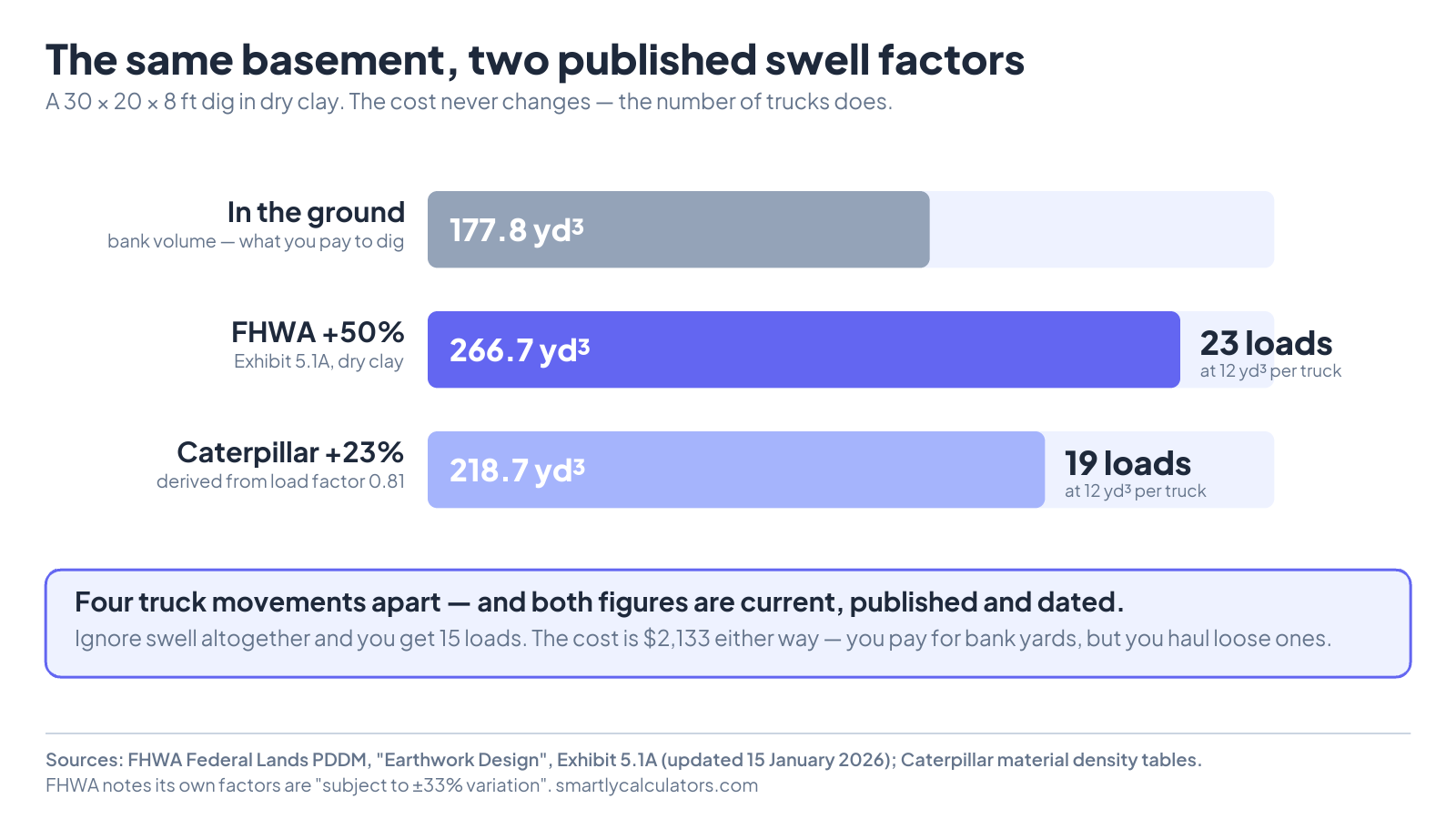
A basement: 30 ft × 20 ft × 8 ft in dry clay, 12-yard trucks, quoted at $12 per yard.
- 30 × 20 × 8 = 4,800 cubic feet ÷ 27 = 177.8 bank yards.
- 177.8 × 1.50 (FHWA’s 50% for dry clay) = 266.7 loose yards.
- 266.7 ÷ 12 = 22.2, rounded up = 23 truck loads.
- 177.8 × $12 = $2,133 for the excavation itself.
Switch the swell to Caterpillar’s 23% for the same dry clay and the cost does not move — it is still $2,133, because cost is priced on bank yards. But the haulage does: 218.7 loose yards and 19 loads instead of 23. Four truck movements, decided entirely by which published source you picked.
Ignore swell altogether and the arithmetic gives 15 loads. That is an eight-load shortfall on a single basement, which is the most common hole in a self-managed dig budget.
A service trench: 60 ft × 2 ft × 4 ft in dry sand, 10-yard trucks. 480 cubic feet ÷ 27 = 17.8 bank yards; at 11% swell that is 19.7 loose yards, so 2 loads. With no rate entered the calculator stops there, which is the honest answer until a contractor gives you a number.
If the dig is for foundations rather than a basement, our groundworks cost calculator prices the concrete and muck-away alongside the excavation on UK rates. For drainage runs, the French drain calculator handles trench depth, stone and pipe sizing.