Quick Answer
A torsion spring calculator sizes garage door springs two ways: door weight × drum radius ÷ (turns × springs) gives the required strength in IPPT, and IPPT = 28,500,000 × d⁴ ÷ (10.8 × mean diameter × active coils) rates an existing spring from its wire size, inside diameter and length. A 150 lb, 7-foot door on 4-inch drums with two springs needs about 20.2 IPPT per spring.
Torsion Spring Formula (IPPT)
This torsion spring calculator works in IPPT — inch-pounds per turn, the torque a spring adds with every full winding turn. Two formulas cover both directions of the problem: what your door needs, and what a given spring delivers.
| Variable | Meaning | Where it comes from |
|---|---|---|
| d (wire size) | Wire diameter in inches | Measure 10 coils, divide by 10 — enters the formula to the 4th power, so 0.243 vs 0.234 wire is a 16% strength jump |
| Dm (mean diameter) | Inside diameter + wire size | ID is cast into the winding cone: 1¾, 2, 2¼ or 2⅝ in on residential doors |
| Na (active coils) | Spring length ÷ wire size | Measure coiled length only — cones excluded |
| Turns | Door height ÷ (π × drum diameter) + 0.75 pretension | A 7-ft door on standard 4-in drums winds to about 7.4 turns |
| Drum radius | Half the cable drum diameter | Torque needed = door weight × radius, so bigger drums demand stronger springs |
To keep the same strength on a different inside diameter, hold the wire size and the IPPT fixed. With Na = length ÷ d, the rate is IPPT = E × d⁵ ÷ (10.8 × Dm × length), so Dm × length must stay the same: L2 = L1 × (ID1 + d) ÷ (ID2 + d). A 0.225 × 2-in × 24-in spring becomes 0.225 × 1¾-in × about 27.04 in at the same 28.5 IPPT. Rate my spring prints this for every inside diameter the calculator offers.
How to Measure Garage Door Spring Wire Size (10-Coil Method)
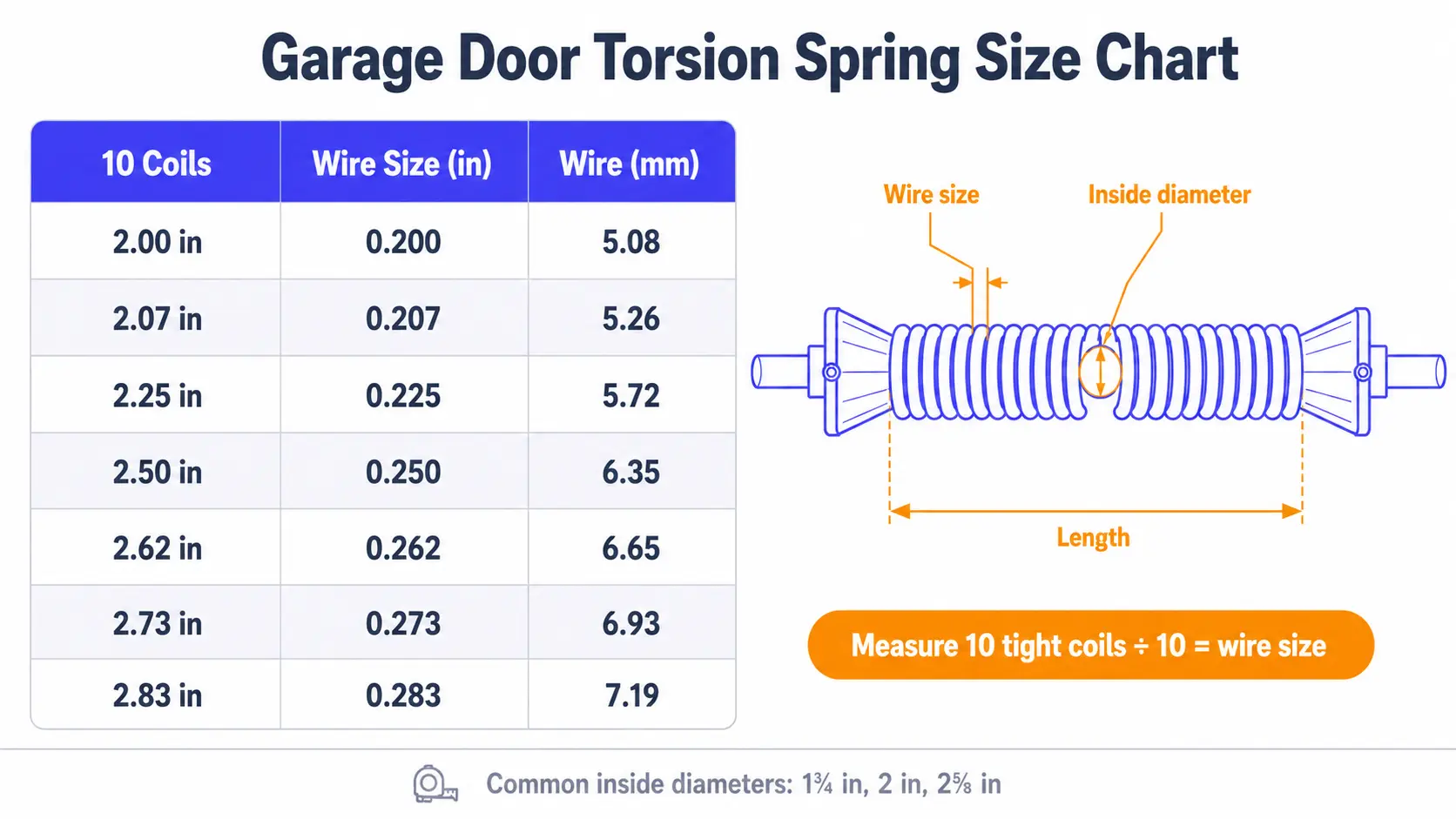
Wire size is the single most important measurement — and the easiest to get wrong with calipers on a greasy spring. The trade method: lay a tape across exactly 10 (or 20) coils, read the length, divide by the coil count.
| 10 coils measure | 20 coils measure | Wire size |
|---|---|---|
| 1.77 in (≈1¾) | 3.54 in | 0.177 |
| 1.92 in (≈1 15/16) | 3.84 in | 0.192 |
| 2.07 in (≈2 1/16) | 4.14 in | 0.207 |
| 2.18 in (≈2 3/16) | 4.36 in | 0.218 |
| 2.25 in (2¼ exact) | 4.50 in | 0.225 |
| 2.34 in (≈2 11/32) | 4.68 in | 0.234 |
| 2.43 in (≈2 7/16) | 4.86 in | 0.243 |
| 2.50 in (2½ exact) | 5.00 in | 0.250 |
| 2.62 in (≈2⅝) | 5.24 in | 0.262 |
| 2.73 in (≈2¾) | 5.46 in | 0.273 |
Garage Door Torsion Spring IPPT Chart (2-inch ID)
Computed with this calculator’s own formula for common 2-inch-ID springs. “Pair balances” assumes two springs on a 7-foot door with standard 4-inch drums (7.43 turns); lengths are typical examples — longer springs of the same wire are weaker per turn but last longer.
| Wire size | Example length | IPPT per spring | Pair balances (7-ft door) |
|---|---|---|---|
| 0.192 | 22 in | 14.3 | ≈ 106 lb |
| 0.207 | 24 in | 18.9 | ≈ 141 lb |
| 0.218 | 26 in | 22.5 | ≈ 167 lb |
| 0.225 | 26 in | 26.3 | ≈ 196 lb |
| 0.234 | 28 in | 29.6 | ≈ 220 lb |
| 0.243 | 30 in | 33.2 | ≈ 247 lb |
| 0.250 | 32 in | 35.8 | ≈ 266 lb |
How to Use the Torsion Spring Calculator
- Pick your direction.
Size a spring starts from your door’s weight and tells you the IPPT to buy. Rate my spring starts from measurements of an existing spring and tells you how strong it is — and how much door it can balance.
- Enter the door setup.
Door height, drum diameter and one spring or two. These set the winding turns (height ÷ π × drum + 0.75 pretension) and the torque the cables see at the drum.
- Weigh the door — don’t guess.
Disconnect the opener, rest the closed door on a bathroom scale, and read the true weight. Guessing is the number-one cause of wrong springs; an insulated double door can weigh double its builder-grade twin.
- Read the results.
Required or measured IPPT per spring, total IPPT, winding turns, drum torque, the door weight your spring balances, active coils and how much the spring grows when wound — plus warnings when a 4-inch drum is overloaded past ~265 lb per cable or the wire size looks off. Rate my spring also prints the spring to order (wire × inside diameter × length) and the length that gives the same strength at each other inside diameter it offers.
Torsion Spring Calculation Examples
Every row below is computed exactly the way the calculator does it — torque = weight × drum radius, turns = height ÷ (π × drum) + 0.75, IPPT = E × d⁴ ÷ (10.8 × Dm × Na).
| Scenario | Inputs | Result |
|---|---|---|
| Standard double door, sizing | 150 lb, 7-ft door, 4-in drums, 2 springs | 300 lb-in torque ÷ 7.43 turns = 40.4 total → 20.2 IPPT per spring |
| Rating an existing pair | 0.225 wire × 2-in ID × 24-in length, ×2 springs | 28.5 IPPT each (107 coils) → pair balances ≈ 212 lb |
| Converting to another inside diameter | The same 0.225 wire × 24-in spring, moving from a 2-in to a 1¾-in ID | 24 × (2 + 0.225) ÷ (1.75 + 0.225) = ≈ 27.04 in at the same 28.5 IPPT |
| Single-spring 8-ft door | 130 lb, 8-ft door, 4-in drums, 1 spring | 8.39 turns → 31.0 IPPT needed on the one spring |
| Overloaded drum (warning case) | 300 lb door, 1 spring, 4-in drums | Needs 80.7 IPPT — and trips the ~265 lb per cable drum warning: split onto two springs or larger drums |
| Spring growth check | 0.225 wire wound 7.43 turns | Spring grows ≈ 1.67 in along the shaft — leave clearance before the cone |
Torsion Spring Safety & Cycle Life
A wound torsion spring stores the full lifting energy of your door — release it the wrong way and the winding cone becomes a projectile. Wind and unwind only with solid steel winding bars that fully seat in the cone (never screwdrivers or rebar), keep your head out of the bar’s arc, and clamp the shaft before touching set screws. If any of that sentence is new, hand the job to a pro and use this calculator to check their quote instead.
Residential springs are usually quoted at a 10,000-cycle rating — roughly 7 years at 4 cycles a day — but that figure is a trade convention, and no source cited on this page establishes it. DASMA’s technical data sheet on spring cycle life states no cycle-life number at all; what it does cover is what shortens whatever life a spring has: corrosion, poor lubrication and doors out of balance. When one spring of a pair breaks, replace both: the survivor has the same mileage. Longer, heavier-wire springs with the same IPPT (high-cycle conversions) trade a few dollars for multiples of the life. Weighing the door for a conversion is the same rise-and-run discipline as any layout job — the stair stringer calculator is this tool’s cousin on the carpentry side of the garage.