Quick Answer
This Case Connect compensation calculator estimates a personal injury settlement using the multiplier method used by insurers and lawyers worldwide: it adds up your economic losses (medical costs, lost earnings and other expenses), then multiplies them by 1.5 to 5 depending on how serious the injury is to estimate pain and suffering. For example, $16,000 of losses from a moderate injury (×2) gives about $32,000 for pain and suffering and roughly $48,000 in total. It is a guide only, not legal advice, and laws differ by country.
How the Case Connect Compensation Calculator Works
A personal injury settlement is made of two parts almost everywhere in the world: the money you actually lost (economic damages) and a figure for the pain, suffering and disruption the injury caused (non-economic damages). This calculator adds your losses, then uses the “multiplier method” — the rule of thumb insurers and lawyers apply — to estimate the pain-and-suffering part.
Pain & suffering = economic damages × severity multiplier (1.5 to 5)
Estimated total = economic damages + pain & suffering
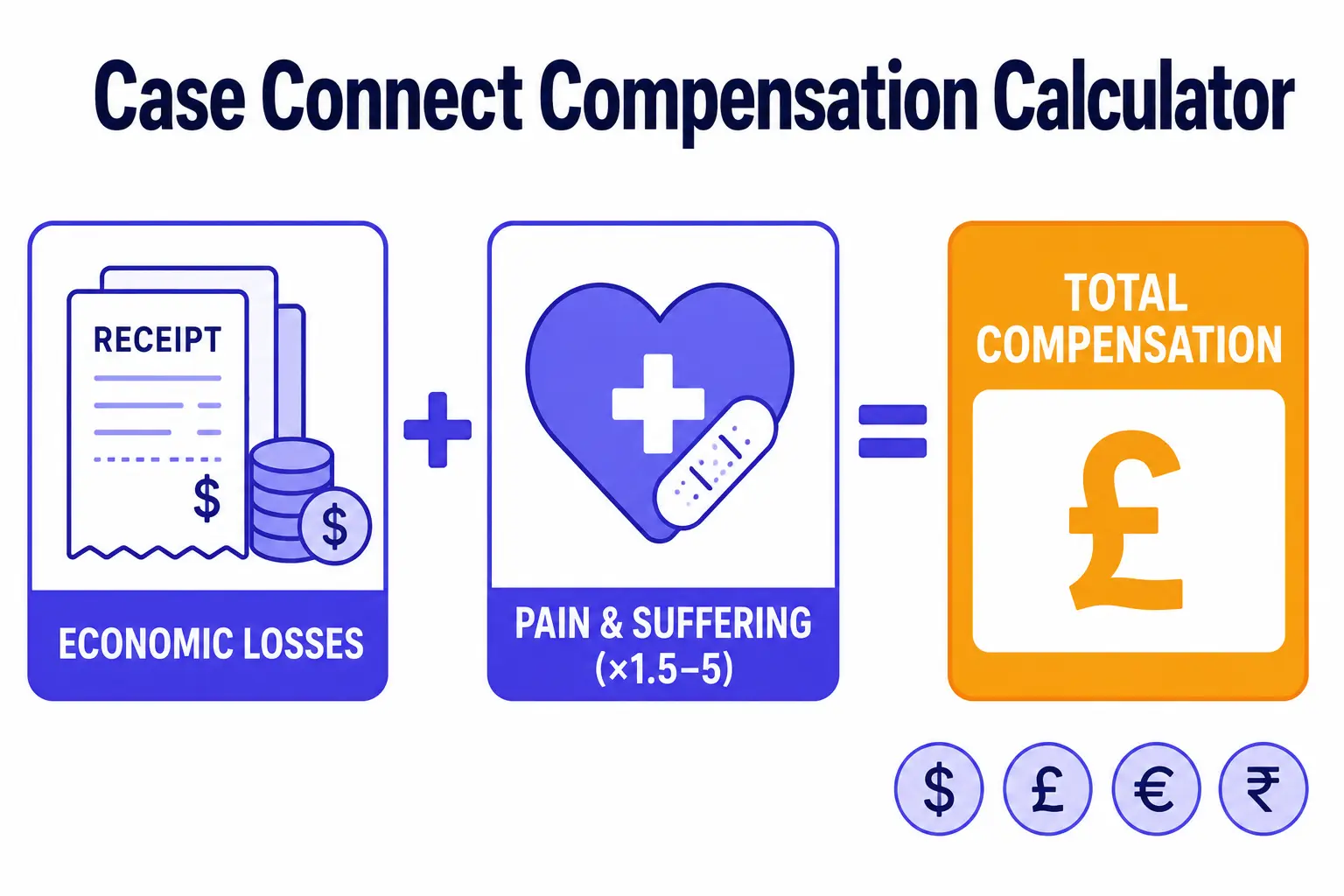
The multiplier reflects how serious and lasting the injury is — a minor sprain that fully heals sits near 1.5, while a life-changing injury sits near 5. It is not fixed by law; insurers, lawyers and courts use it as a starting point, then adjust for fault, evidence and local rules. Works in any currency — pick yours above.
How to Use the Compensation Calculator
-
Pick your currency and severity
Choose your currency, then how serious the injury is — the severity sets the multiplier (minor 1.5× up to catastrophic 5×).
-
Enter your medical costs
All treatment from the injury: hospital, surgery, physiotherapy, prescriptions and any future care you’ll still need.
-
Add lost earnings and other expenses
Income lost while off work, plus travel to appointments, care at home and damaged property.
-
Read the estimate
You get your economic damages, the pain-and-suffering figure and the estimated total. Share a link to save your figures.
The Multiplier Method: Choosing 1.5 to 5
The multiplier is chosen from the severity of the injury. As a guide:
| Severity | Multiplier | Typical injury |
|---|---|---|
| Minor | ×1.5 | Soft-tissue injury, sprain — full recovery expected |
| Moderate | ×2 | Broken bone that heals well, short-term impact |
| Serious | ×3 | Lasting pain or reduced function, longer recovery |
| Severe | ×4 | Permanent disability or disfigurement |
| Catastrophic | ×5 | Life-changing injury (brain, spinal, multiple) |
Some professionals use the per diem (“per day”) method instead: a daily rate — often the equivalent of $100–$500 — multiplied by the number of days you were in pain. The multiplier method is the more common of the two for larger or longer-lasting injuries.
Worked Examples: Multiplier Method
Every figure below is exactly what the calculator prints — enter the same inputs to check (shown in $, but any currency works the same way).
| Economic damages | Severity | Pain & suffering | Estimated total |
|---|---|---|---|
| $5,000 | Minor (×1.5) | $7,500 | $12,500 |
| $16,000 | Moderate (×2) | $32,000 | $48,000 |
| $30,000 | Serious (×3) | $90,000 | $120,000 |
| $50,000 | Severe (×4) | $200,000 | $250,000 |
| $100,000 | Catastrophic (×5) | $500,000 | $600,000 |