

Quick Answer
A volume calculator finds the 3D space inside a shape from its measurements: for a box, volume = length × width × height; for a sphere, V = 4⁄3 π r³; for a cylinder, V = π r² h. Enter your dimensions in any length unit (from millimeters to miles) and read the result instantly in cubic units, liters, or gallons.
Volume Formulas for Every Shape
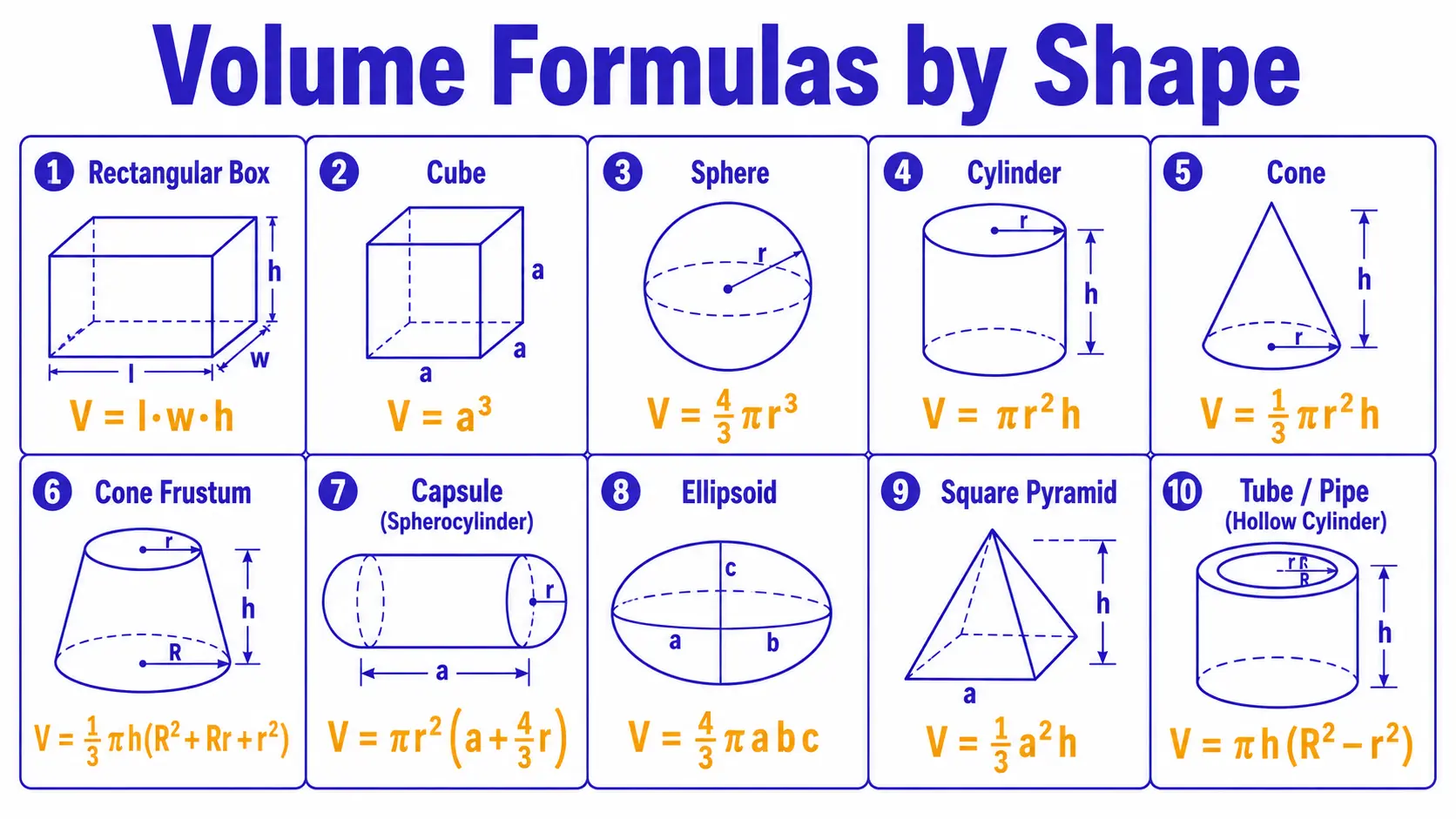
Volume measures the space a solid occupies, in cubic units. Each shape has its own formula built from its dimensions — a length, a radius, or a set of axes. This calculator covers the ten shapes below, takes every dimension in its own unit, converts to metres before it multiplies, and converts the answer to any of twelve volume units.
| Shape | Formula | Example | Volume |
|---|---|---|---|
| Box | V = l × w × h | 50 × 40 × 30 cm | 60 L |
| Cube | V = a³ | a = 10 cm | 1 L |
| Sphere | V = 4⁄3 π r³ | r = 10 cm | 4.189 L |
| Cylinder | V = π r² h | r 10, h 20 cm | 6.283 L |
| Cone | V = 1⁄3 π r² h | r 10, h 20 cm | 2.094 L |
| Cone frustum | V = 1⁄3 π h (R² + R·r + r²) | R 12, r 6, h 20 cm | 5.278 L |
| Capsule | V = π r² (a + 4⁄3 r) | r 5, a 20 cm | 2.094 L |
| Ellipsoid | V = 4⁄3 π a b c | a 10, b 8, c 6 cm | 2.011 L |
| Square pyramid | V = 1⁄3 a² h | a 12, h 18 cm | 0.864 L |
| Tube / pipe | V = π h (R² − r²) | R 10, r 8, h 30 cm | 3.393 L |
A frustum is not simply a cone with the top removed at the same height. Tapering from R 12 cm to r 6 cm over 20 cm gives 5.278 L, while a full cone with the same 12 cm base and the same 20 cm height gives only 3.016 L — the frustum is wider at every level above the base, so it holds 75% more. A capsule works the other way round and is easier: it is a cylinder plus one whole sphere of the same radius, which is why r 5, a 20 cm comes to 2.094 L against the plain cylinder’s 1.571 L.
Two Mistakes That Change the Answer
Nearly every wrong volume comes from one of two places, and neither is the formula.
The second is mixing up volume with area. Area covers a surface and is measured in square units; volume fills a space and is measured in cubic units. Paint and flooring are area problems; water, soil, concrete and air are volume problems. If your answer needs to be in m², you are on the wrong calculator — and the section on circles below is the same confusion in its most common form.
How to Use the Volume Calculator
- Pick the shape
Choose from the ten shapes at the top. The input fields change to match, so you only ever see the dimensions that shape actually needs — one for a cube, three for a frustum.
- Enter each dimension in its own unit
Every field has its own picker covering eleven length units, from miles down to angstroms. A tank measured 4 ft long and 60 cm wide needs no conversion from you; the tool converts each dimension to metres before it multiplies.
- Choose the output unit
Twelve options, from cubic millimetres to cubic miles, plus litres, millilitres, US gallons and imperial gallons. Litres is the default.
- Check the working
The steps card shows the formula, the substitution with your numbers converted to metres, and the result. If a number looks wrong, that middle line is where the mistake will be visible.
Tube and Pipe Volume: the Wall, or What Fits Inside?
This is the question that trips people up, and the answer depends on which one you actually want.
Which one you need depends on the job. The wall volume is what you want for the weight of a length of pipe, or how much material a casting takes. The bore volume is what you want for how much water a run of pipe holds, how long it takes to flush, or how much a heating system needs to fill. Since pipes are specified by internal diameter, this table gives the capacity directly.
| Internal diameter | Litres per metre | Litres per 10 m | US gallons per 10 m |
|---|---|---|---|
| 10 mm | 0.07854 | 0.7854 | 0.20748 |
| 15 mm | 0.17671 | 1.767 | 0.46683 |
| 20 mm | 0.31416 | 3.142 | 0.82992 |
| 25 mm | 0.49087 | 4.909 | 1.297 |
| 32 mm | 0.80425 | 8.042 | 2.125 |
| 50 mm | 1.963 | 19.635 | 5.187 |
| 75 mm | 4.418 | 44.179 | 11.671 |
| 100 mm | 7.854 | 78.54 | 20.748 |
| 150 mm | 17.671 | 176.715 | 46.683 |
Capacity scales with the square of the diameter, which is why the jumps are so large: doubling from 50 mm to 100 mm does not double the capacity, it quadruples it, from 1.963 to 7.854 litres per metre. Once you have the volume, turning it into a weight is a density problem — our grams to mL converter does that step for liquids other than water.
A Circle Has No Volume
Searches for a volume of a circle are common, and the honest answer is that a circle cannot have one. A circle is a flat, two-dimensional shape: it has an area, π r², measured in square units. Volume needs a third dimension. At r = 10 cm the circle’s area is 314.159 cm², and that is the end of what a circle can tell you.
Volume Unit Conversions
The conversions are exact by definition rather than rounded approximations, because they all derive from exact length definitions: a foot is 0.3048 m and an inch is 0.0254 m, as set out in NIST Special Publication 811, Appendix B.8. The two gallons are different sizes and always have been: the US gallon is 3.785411784 L, while the imperial gallon is 4.54609 L, defined in the Schedule to the Units of Measurement Regulations 1995.
| 1 cubic metre equals | Value |
|---|---|
| Litres | 1,000 L |
| Cubic feet | 35.315 ft³ |
| Cubic inches | 61,023.74 in³ |
| Cubic yards | 1.308 yd³ |
| US gallons | 264.172 |
| Imperial gallons | 219.969 |
Going the other way: one cubic foot is 28.317 L, one US gallon is 3.785 L, one imperial gallon is 4.546 L, and one litre is 61.024 cubic inches. The 20% gap between the two gallons is the single most common source of wrong tank figures — the same tank is 20 US gallons or 16.65 imperial, and our aquarium volume calculator reports both for exactly that reason.
Real Jobs That Are Volume Problems
Most people arrive here with a job rather than a shape. These are the four that come up most, with the shape each one really is.
| Job | Shape to pick | Example | Volume |
|---|---|---|---|
| Swimming pool | Box, using average depth | 10 × 4 m, avg depth 1.5 m | 60 m³ · 60,000 L · 15,850.32 US gal |
| Room air volume | Box | 4.2 × 4.8 m, ceiling 2.4 m | 48.384 m³ · 1,708.66 ft³ |
| Shipping crate | Box | 120 × 100 × 100 cm | 1.2 m³ · 42.378 ft³ · 1.57 yd³ |
| Round tank or drum | Cylinder | r 10 cm, h 20 cm | 6.283 L |
The pool row is the one worth explaining. A pool that slopes from 1.0 m at the shallow end to 2.0 m at the deep end has an average depth of 1.5 m, so the plain box formula still applies — length × width × average depth. You do not need a special pool formula, you need the right depth. A smaller 8 × 4 m pool at 1.4 m average is 44.8 m³, or 11,834.91 US gallons.
For freight, the number a carrier wants is usually cubic feet or cubic yards rather than cubic metres, which is why the output unit picker matters: a 48 × 40 × 45 in crate is 50 ft³ exactly, or 1.852 yd³. And for a fish tank, use the aquarium volume calculator instead — it subtracts substrate and the rim gap, which a plain box calculation will not.
How to Find the Volume of an Irregular Shape
None of the ten formulas fits a rock, a casting or a piece of driftwood. Two methods work, and both are more reliable than trying to force an odd shape into a formula.
- Break it into shapes you do have
Most real objects are a few simple solids stuck together. A bottle is a cylinder plus a frustum plus a short neck cylinder. Calculate each part separately and add the results. This is the better method whenever the object is too big or too awkward to submerge.
- Or measure by displacement
Fill a container with enough water to cover the object, note the level, lower the object in fully, and note the new level. The rise is the object’s volume. In a straight-sided container you can work it out as area × rise; in a measuring jug just read the difference in millilitres, since 1 mL is exactly 1 cm³.
- Watch the two things that spoil it
The object must be fully submerged and must not float, so weigh it down with something whose volume you can subtract afterwards. And it must not absorb water — wood, foam and unglazed pottery all soak it up, which makes the rise read low. Seal them, or use the first method.