

Quick Answer
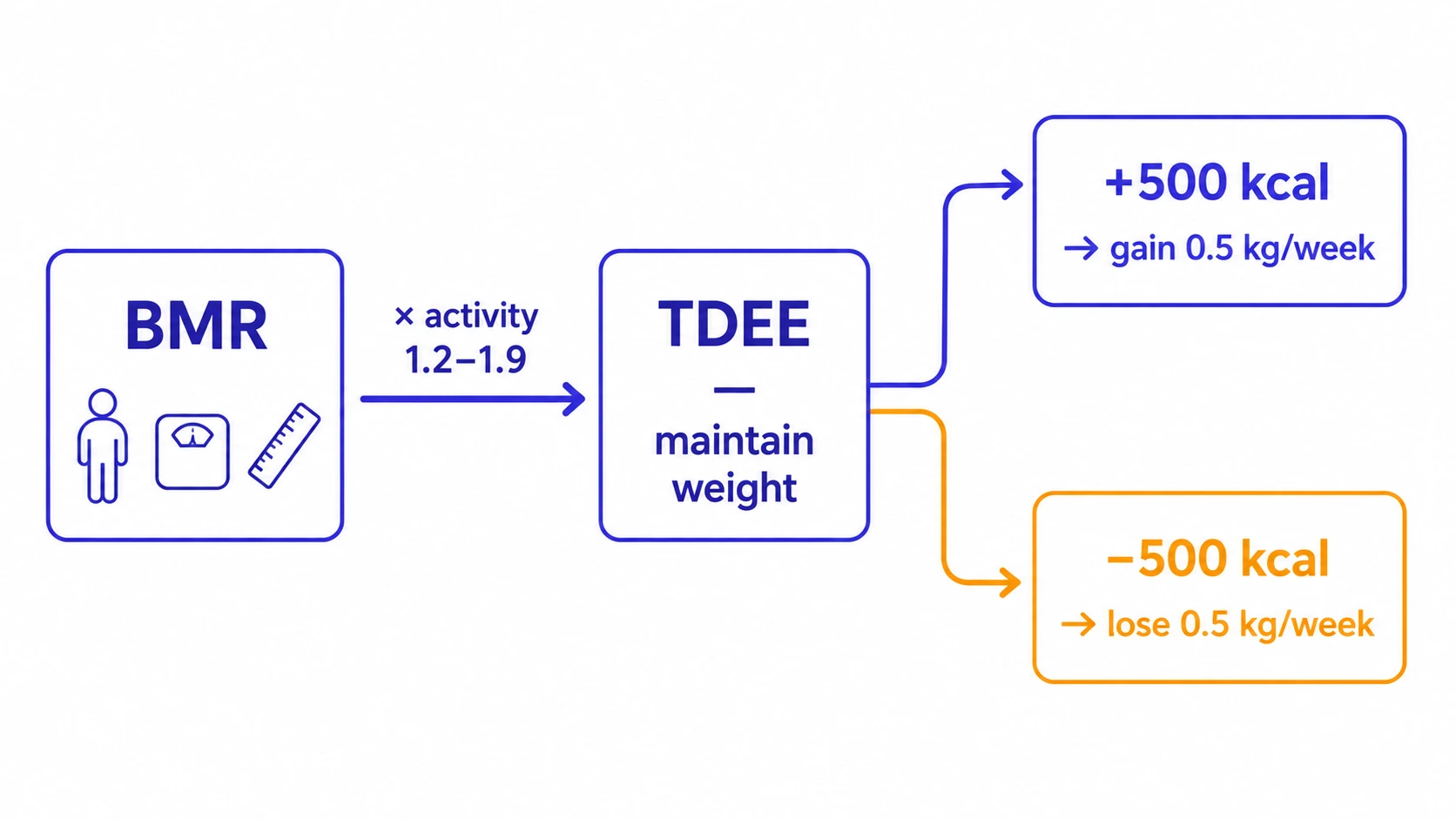
This calorie calculator estimates your daily energy needs with the Mifflin-St Jeor equation: BMR = 10×weight(kg) + 6.25×height(cm) − 5×age + 5 for men (−161 for women), then multiplies BMR by an activity factor of 1.2–1.9 to get your maintenance calories (TDEE). Subtract 250–500 kcal/day to lose about 0.25–0.5 kg per week, or add the same to gain.
Calorie Calculator Formula: Mifflin-St Jeor BMR & TDEE
The calculator first finds your basal metabolic rate (BMR) — the calories your body burns at complete rest — using the Mifflin-St Jeor equation, which a 2005 systematic review found predicts resting metabolic rate within ±10% of measured values more often than any other standard formula. Your BMR is then multiplied by an activity factor to get your total daily energy expenditure (TDEE), the calories you need to maintain your current weight.
Men: BMR = 10 × weight (kg) + 6.25 × height (cm) − 5 × age + 5
Women: BMR = 10 × weight (kg) + 6.25 × height (cm) − 5 × age − 161
TDEE = BMR × activity multiplier
| Activity level | Multiplier | Typical routine |
|---|---|---|
| Sedentary | 1.2 | Little or no exercise |
| Lightly active | 1.375 | Exercise 1–3 days/week |
| Moderately active | 1.55 | Exercise 3–5 days/week |
| Very active | 1.725 | Exercise 6–7 days/week |
| Extra active | 1.9 | Hard exercise plus a physical job |
How to Use the Calorie Calculator
- Set your gender and units.
Tap Male or Female, then Metric (kg, cm) or Imperial (lb, ft + in) — the height fields switch automatically.
- Enter your age, weight, and height.
Type the numbers straight in; no rounding needed.
- Pick your activity level.
Choose the option that matches your real weekly routine, not your goal — this sets the multiplier from the table above. If you already track your steps, the steps to calories calculator turns a real daily count into a measured figure rather than a bracket.
- Read your targets on the right.
The big number is your maintenance calories (TDEE). The four cards below it show daily targets for mild loss (−250 kcal), loss (−500 kcal), mild gain (+250 kcal), and gain (+500 kcal).
Worked Examples: Maintenance, Deficit & Surplus Calories
Metric example. A 28-year-old man, 70 kg, 175 cm, moderately active (×1.55): BMR = 10×70 + 6.25×175 − 5×28 + 5 = 1,659 kcal. TDEE = 1,659 × 1.55 ≈ 2,571 kcal/day to maintain weight — so about 2,071 kcal/day to lose 0.5 kg per week, or 3,071 kcal/day to gain it.
Imperial example. A 40-year-old woman, 150 lb, 5 ft 4 in, lightly active (×1.375): the calculator converts to 68 kg and 162.6 cm, giving BMR = 1,335 kcal and TDEE ≈ 1,836 kcal/day. Her weight-loss target of 1,336 kcal/day stays above the 1,200 kcal safety floor, so no warning appears.
| Goal | Daily target | Approx. weekly change |
|---|---|---|
| Maintain weight | TDEE | 0 kg |
| Mild weight loss | TDEE − 250 kcal | −0.25 kg (−0.5 lb) |
| Weight loss | TDEE − 500 kcal | −0.5 kg (−1 lb) |
| Mild weight gain | TDEE + 250 kcal | +0.25 kg (+0.5 lb) |
| Weight gain | TDEE + 500 kcal | +0.5 kg (+1 lb) |