Quick Answer
A JAWS tax calculator turns any one Australian pay figure into all the others. On the ATO 2026-27 resident rates a $90,000 salary pays $17,520 income tax plus an $1,800 Medicare levy, leaving $70,680 take-home, or $1,359.23 a week. This tool also runs that backwards: type a take-home figure and it returns the gross salary that produces it.
JAWS Tax Calculator: What It Is and What This One Adds
This is not JAW’s Oz Tax Calculator. “JAWS tax calculator” is what most people type when they are looking for JAW’s Oz Tax Calculator, a separate Australian tax tool built and maintained by someone else. The calculator above is an independent build of the same idea.
The idea worth copying is the reversible one: type any one figure and get every other one back. This version adds the parts a quick gross-to-net tool usually drops — the low income tax offset, the shading-in range where the Medicare levy phases up from nothing to 2%, and a compulsory HECS/HELP repayment on the current marginal scale — then restates the answer per year, month, fortnight and week. Three financial years and three residency positions are covered, and the reverse mode solves the same model rather than a simplified copy of it, so gross and take-home can never disagree.
Australian Income Tax Formula and 2026–27 Rates
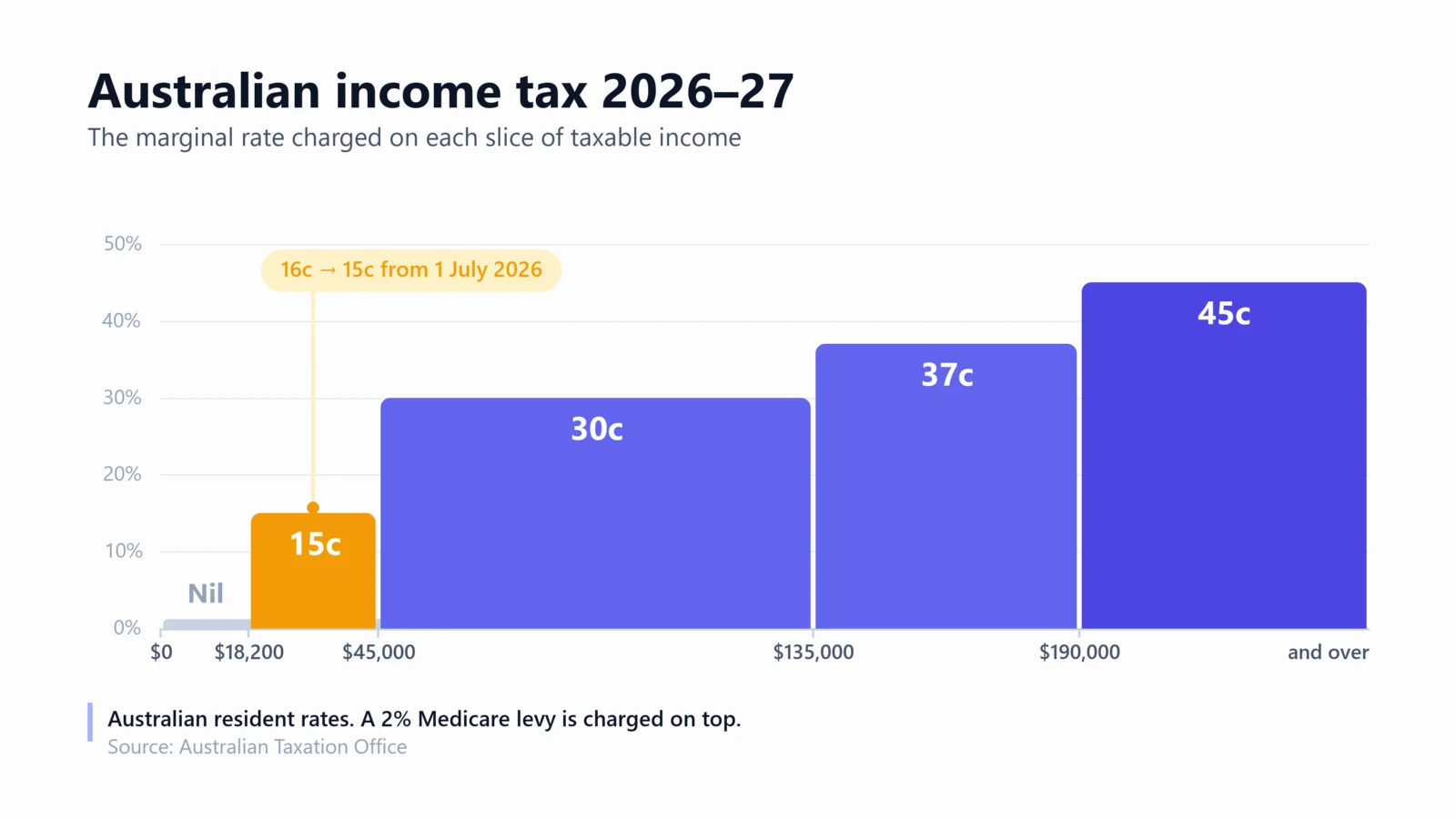
Australian income tax is marginal: each rate applies only to the slice of taxable income inside its bracket, never to the whole amount. The ATO resident scale is then adjusted by two things before you get a final number.
Take-home = taxable income − (income tax − LITO) − Medicare levy − HELP repayment. The low income tax offset is worth up to $700 and can cancel income tax but never create a refund. The Medicare levy is 2%, shaded in at 10c per dollar above $28,011, whichever is less. That threshold is the ATO’s 2025–26 figure; no 2026–27 pair has been published yet, so the same one is used for both years here.
| Taxable income (2026–27) | Tax on this income |
|---|---|
| $0 – $18,200 | Nil |
| $18,201 – $45,000 | 15c for each $1 over $18,200 |
| $45,001 – $135,000 | $4,020 plus 30c for each $1 over $45,000 |
| $135,001 – $190,000 | $31,020 plus 37c for each $1 over $135,000 |
| $190,001 and over | $51,370 plus 45c for each $1 over $190,000 |
Foreign residents pay 30c from the first dollar with no tax-free threshold, no offset and no Medicare levy. Working holiday makers pay 15c on the first $45,000, then the same upper brackets. On a $90,000 salary that is $70,680 in the hand as a resident, $69,750 as a working holiday maker and $63,000 as a foreign resident.
How to Use the JAWS Tax Calculator
- Type one amount and pick its period.
Enter a salary, a wage or what actually lands in your account, then choose per year, month, fortnight or week beside the box.
- Say what that amount is.
Leave it on gross for a normal calculation. Switch it to take-home and the tool runs backwards to find the salary that produces the figure you typed.
- Set your year, residency and HECS debt.
2026–27 is the current financial year. Switch HECS/HELP to yes if you have a study loan — a repayment is withheld once your income passes $69,528.
Worked Examples: $90,000 Salary, a HECS Debt and a Reverse Lookup
| Taxable income | Income tax | Medicare levy | Take-home a year | A week | Average rate |
|---|---|---|---|---|---|
| $30,000 | $1,070.00 | $198.90 | $28,731.10 | $552.52 | 4.2% |
| $45,000 | $3,695.00 | $900.00 | $40,405.00 | $777.02 | 10.2% |
| $60,000 | $8,420.00 | $1,200.00 | $50,380.00 | $968.85 | 16.0% |
| $75,000 | $13,020.00 | $1,500.00 | $60,480.00 | $1,163.08 | 19.4% |
| $90,000 | $17,520.00 | $1,800.00 | $70,680.00 | $1,359.23 | 21.5% |
| $120,000 | $26,520.00 | $2,400.00 | $91,080.00 | $1,751.54 | 24.1% |
| $150,000 | $36,570.00 | $3,000.00 | $110,430.00 | $2,123.65 | 26.4% |
| $200,000 | $55,870.00 | $4,000.00 | $140,130.00 | $2,694.81 | 29.9% |
Add a HECS debt to that $90,000. Repayment income is $20,472 above the $69,528 threshold, and the first band takes 15c in the dollar, so $3,070.80 comes out on top of the tax. Take-home drops from $1,359.23 to $1,300.18 a week and the average rate rises from 21.5% to 24.9%.
Run it backwards. Set the amount to $1,200, the period to per week and the basis to take-home: the salary that leaves exactly that is $77,823.53, made up of $13,867.06 income tax and $1,556.47 Medicare levy.
Where both adjustments bite. On $35,000 the raw tax is $2,520, the low income tax offset knocks $700 off it, and the Medicare levy comes in at $698.90 rather than the flat 2% of $700, because the shading-in calculation is the smaller of the two. Total $2,518.90, or 7.2%.
What this does not include. The Medicare levy surcharge, private health rebates, SAPTO, salary sacrifice, employer super and any deduction you have not already subtracted are all outside the model, and PAYG withheld each payday can differ from the final assessment. Centrelink payments are treated differently again — use the Centrelink income test calculator for those, and the Share Incentive Plan calculator if your question is about a UK share scheme.
JAWS Tax Calculator: FAQ
It is JAW’s Oz Tax Calculator at jaws.tips, a long-running Australian income tax tool where you fill in any one of gross, tax or take-home and it returns the rest. The calculator on this page is a separate build of the same idea, using the ATO’s published 2026–27, 2025–26 and 2024–25 rates.
Yes — set “That amount is” to take-home and enter what lands in your account. It solves the same forward model in reverse, so the gross salary it returns reproduces your take-home figure to the cent, including the Medicare levy and any HECS repayment.
The tax-free threshold is $18,200, but the low income tax offset cancels the tax above it for a while longer: in 2026–27 the first taxed dollar arrives at $22,867. In 2025–26 it was $22,576, and the Medicare levy does not start until $28,011 — the ATO’s 2025–26 low-income threshold, carried forward here because no 2026–27 figure has been published.
The rate on income between $18,201 and $45,000 dropped from 16c to 15c on 1 July 2026. That band is $26,800 wide, so the cut is worth exactly $268 a year to everyone earning above $45,000 — the same $268 whether you earn $50,000 or $500,000.
Yes, on the marginal scale that replaced the old whole-of-income rates. For 2026–27 nothing is repaid below $69,528, then 15c in the dollar to $129,717 and $9,028 plus 17c above that. Pick 2024–25 and it switches back to the old table, where a single rate applied to your entire repayment income. See the ATO repayment thresholds.
No, deliberately. The surcharge depends on family status, dependants and how many days you held hospital cover, so a single tick-box would give families a wrong answer. For 2026–27 it starts above $105,000 for singles and $210,000 for families, at 1% rising to 1.5%.