Quick Answer
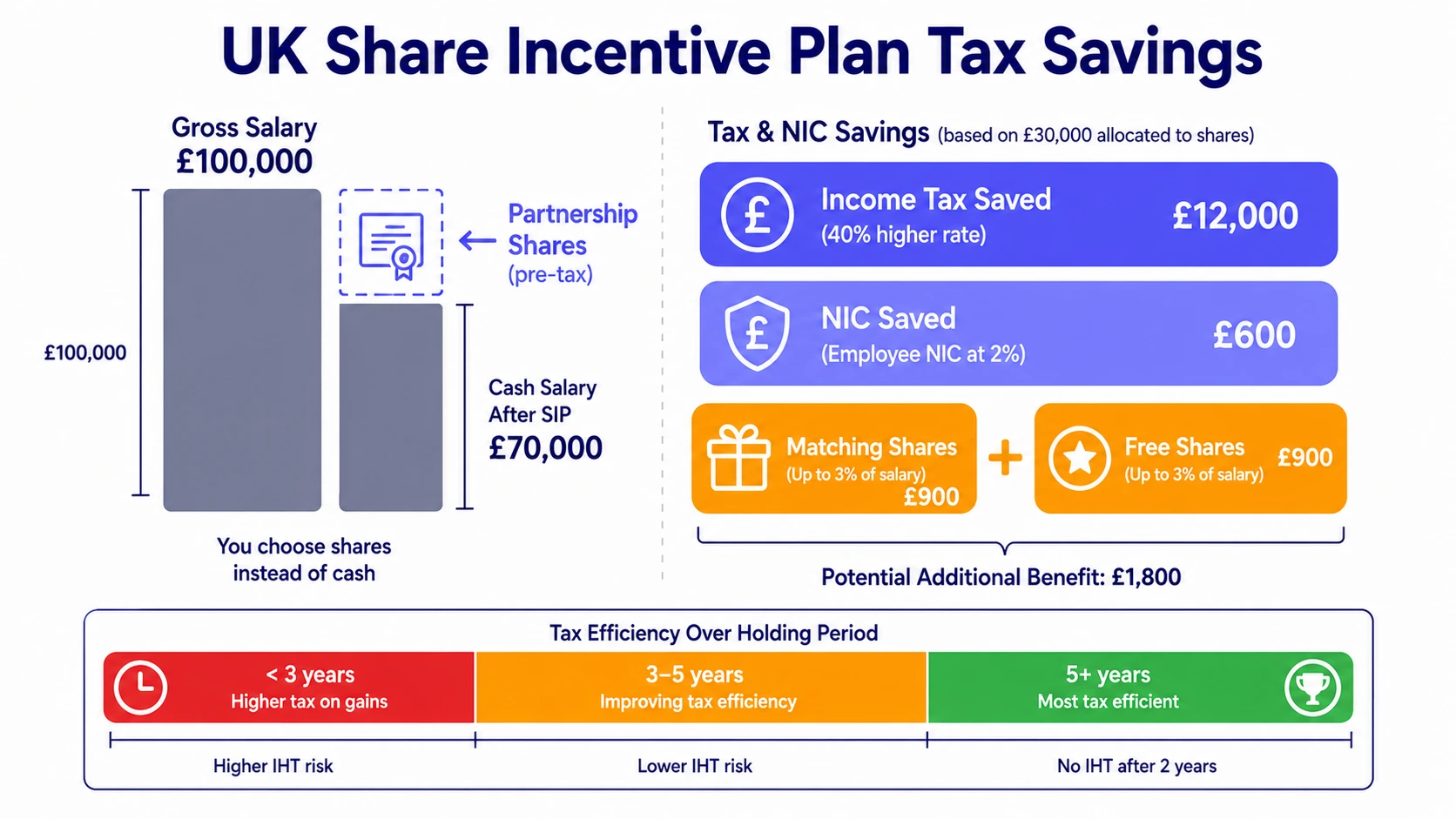
A Share Incentive Plan lets you buy partnership shares from pre-tax salary, so a basic-rate taxpayer saves 28p in every £1 (20% income tax + 8% National Insurance) and a higher-rate taxpayer saves 42p or 48p. You can put in up to £1,800 a year or 10% of your salary, whichever is lower, and shares kept in the plan for 5 years come out with no income tax or NIC at all.
How the SIP Tax Saving Works
A Share Incentive Plan is the only UK employee share scheme where the money never passes through tax. Partnership shares are bought straight out of gross salary, so every pound you put in escapes income tax and National Insurance at your marginal rate. That is the whole engine — this share incentive plan calculator simply applies your rate to your contribution and adds whatever your employer puts on top.
Contribution cap = £1,800 a year, or 10% of salary — whichever is lower
After 5 years in the plan = no income tax and no National Insurance on the shares
How much you keep depends on the band your contribution comes out of:
| Your position | Income tax | National Insurance | Saved per £1 |
|---|---|---|---|
| Basic rate | 20% | 8% | 28p |
| Higher rate, earnings under the upper limit | 40% | 8% | 48p |
| Higher rate, earnings over the upper limit | 40% | 2% | 42p |
| Additional rate | 45% | 2% | 47p |
The National Insurance column is the part most calculators get wrong. Employee NIC is 8% on earnings between the primary threshold and the upper earnings limit, and only 2% above it — so a higher-rate taxpayer well past that limit saves 42p per £1, not 48p. Pick the right NIC chip in the tool and the answer changes accordingly.
The 4 Types of SIP Shares
HMRC allows four routes into a Share Incentive Plan, and most employers run two or three of them. Only partnership shares cost you anything — the rest are given by your employer or bought with your own dividends.
| Share type | Where it comes from | Annual limit |
|---|---|---|
| Free shares | Given by your employer | Up to £3,600 of shares per tax year |
| Partnership shares | Bought from your salary before tax | £1,800, or 10% of your income — whichever is lower |
| Matching shares | Given by your employer on top | Up to 2 free shares for each partnership share |
| Dividend shares | Bought with dividends from your other plan shares | Only if your employer’s scheme allows it |
Matching shares are the part worth chasing. A 2:1 match means your employer hands you £2 of shares for every £1 you contribute — before the tax saving is even counted. If your scheme offers a match and you are not taking it, that is the largest number on this page you are leaving behind.
The 3-Year and 5-Year Rules
A SIP rewards patience with a cliff, not a slope. Take shares out early and HMRC treats their value as employment income; leave them the full five years and the tax disappears completely.
| Time in the plan | What happens on withdrawal |
|---|---|
| Under 3 years | Income tax and NIC on the full market value of the shares when they come out |
| 3 to 5 years | Income tax and NIC on the lower of what you paid or the value at withdrawal |
| 5 years or more | No income tax and no National Insurance at all |
| Dividend shares, 3 years or more | No income tax on the dividend shares |
The middle band is the one people miss. Between three and five years the tax is charged on the lower of the two figures, so if the share price has risen, the growth above your purchase price comes out untaxed even before you reach five years.
What Happens to Your SIP If You Leave
Shares must come out of the plan when you stop working for the company, and that is where the five-year clock usually breaks. But HMRC recognises a set of “good leaver” reasons where no income tax is charged, whatever the holding period.
Under HMRC’s good leaver rules, there is no income tax charge when shares leave the plan because you stopped being employed for any of these reasons:
-
Injury or disability
You leave because you are no longer able to do the job.
-
Redundancy
You are dismissed by reason of redundancy.
-
A TUPE transfer
Your employment transfers under the Transfer of Undertakings (Protection of Employment) Regulations 2006.
-
Your employer stops being an associated company
A change of control, or other circumstances that end that company’s status as an associated company.
-
Retirement
You leave by reason of retirement.
-
Death
The shares pass to your estate with no income tax charge.
Resigning for a better job is not on that list. If you leave voluntarily inside five years, the normal charges in the table above apply — which is worth pricing into a move if you are sitting on a large plan holding.
Capital Gains Tax and the 90-Day ISA Transfer
The five-year rule kills the income tax. Capital Gains Tax is a separate question, and it only starts once the shares are out of the plan.
While shares sit inside the SIP there is no CGT to worry about, and there is no CGT if you sell them at the moment they leave the plan. The exposure begins if you take the shares out, hold them personally, and they rise in value before you sell — that growth is a normal capital gain.
This is the step most people never take. Shares come out at five years, sit in a nominee account, grow, and then trigger a CGT bill years later — when a transfer inside the first 90 days would have sheltered them permanently.
How to Use the Share Incentive Plan Calculator
-
Enter your gross annual salary
This sets your 10% cap. On £15,000 the cap is £1,500 a year, which bites before the £1,800 limit does.
-
Enter your monthly partnership contribution
The tool caps it at £150 a month, because £150 × 12 is exactly the £1,800 annual limit.
-
Pick your tax band and NIC rate
Choose 2% NIC if your earnings are above the upper earnings limit — this is what changes a 48p saving into 42p.
-
Add matching and free shares
Set your employer’s match to 1:1 or 2:1 and add any free shares, up to the £3,600 limit.
-
Set the holding period
The result shows your annual saving, the projected plan value and the tax status of the shares at that point.
SIP Tax Saving Examples
Every figure below is exactly what the calculator prints — enter the same inputs to check.
| Situation | Annual contribution | Annual tax + NIC saved | Plan value after 5 yrs at 5% |
|---|---|---|---|
| £40,000 salary, £125/mo, basic rate, 1:1 match | £1,500 | £420.00 | £16,576.89 |
| £40,000 salary, £150/mo (at the cap), basic rate, 1:1 | £1,800 | £504.00 | £19,892.27 |
| £60,000 salary, £150/mo, higher rate, 8% NIC, no match | £1,800 | £864.00 | £9,946.14 |
| £60,000 salary, £150/mo, higher rate, 2% NIC, 2:1 match | £1,800 | £756.00 | £29,838.41 |
| £130,000 salary, £150/mo, additional rate, 2% NIC, 1:1 | £1,800 | £846.00 | £19,892.27 |
| £15,000 salary, £150/mo — 10% cap bites, basic, 1:1 | £1,500 | £420.00 | £16,576.89 |
| £40,000, £125/mo plus £1,000 free shares, basic, 1:1 | £1,500 + £1,000 free | £420.00 | £22,102.53 |
Notice the third and fourth rows. The higher-rate employee with no match saves more tax (£864 against £756) but ends up with a third of the plan value, because a 2:1 match is worth far more than the extra 6p of NIC relief. If your scheme matches, take the match. More UK money tools are in our finance calculators.