Quick Answer
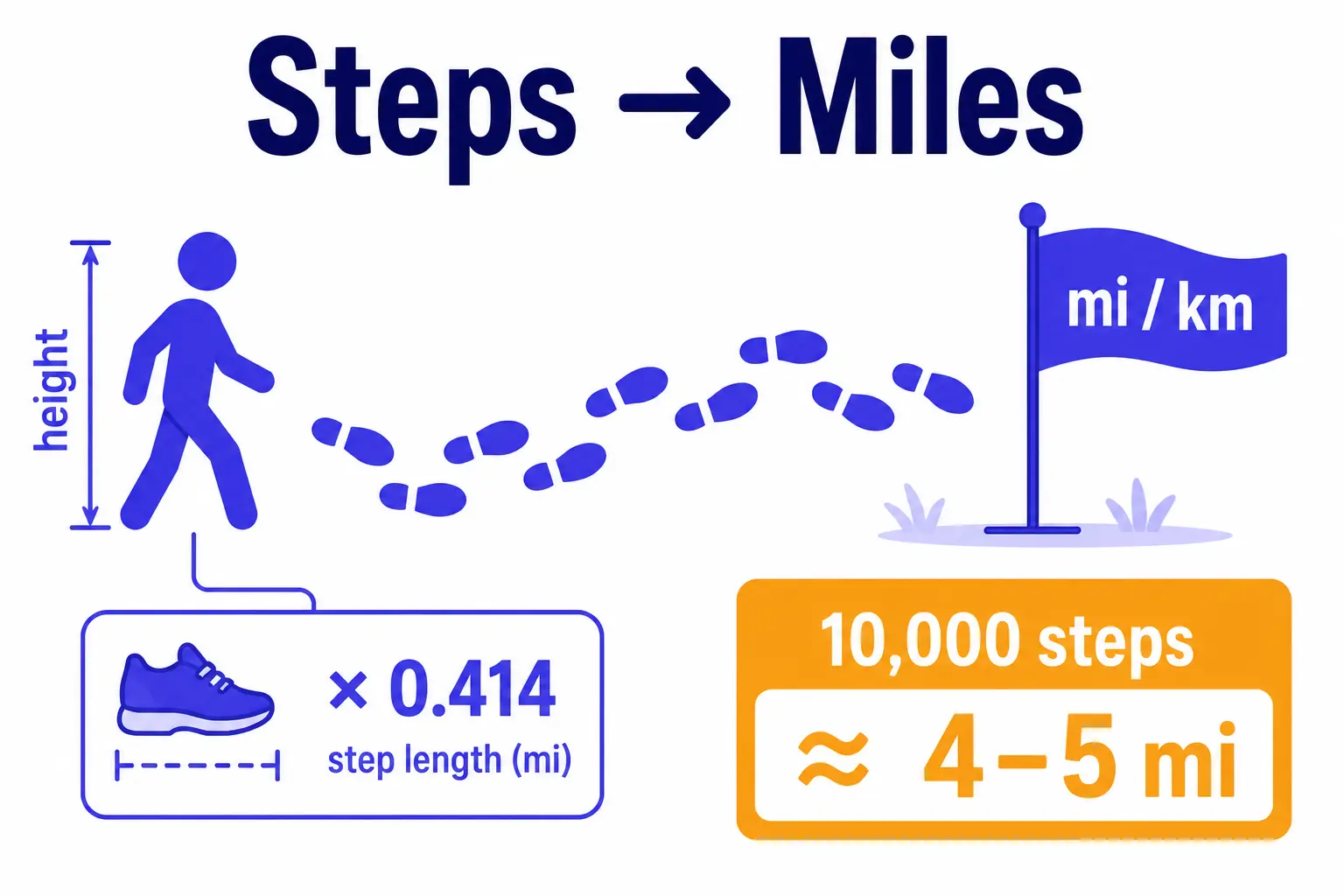
A 170 cm (5 ft 7 in) walker takes about 2,287 steps per mile, so 17,000 steps is 7.43 miles (11.96 km) and 10,000 steps is 4.37 miles (7.04 km). To convert any count, multiply steps by your step length in feet and divide by 5,280 — step length is about 41% of your height when walking. A 6 ft walker covers 17,000 steps in 8 miles; a 5 ft walker in 6.66.
How to Convert Steps to Miles
A step count on its own is not a distance. It becomes one only when you know how far a single step carries you, and that depends mostly on how tall you are. This calculator estimates your step length from your height and your pace, multiplies it by the number of steps, then divides by the 5,280 feet in a mile.
miles = steps × (step length ÷ 12) ÷ 5,280 | km = miles × 1.609344
So a 5 ft 6 in walker has a 27.3 in step and covers 4.31 miles in 10,000 steps. A 6 ft 0 in walker covers 4.7 miles for exactly the same count.
Steps to Miles at Three Heights
Every figure below is the calculator’s own output for walking. Read across a row and the size of the height effect is obvious: by 20,000 steps, a 6 ft 0 in walker has covered 1.57 miles more than a 5 ft 0 in walker (9.41 against 7.84 miles).
| Steps | 5 ft 0 in | 5 ft 6 in | 6 ft 0 in | km at 5 ft 6 in |
|---|---|---|---|---|
| 1,000 | 0.39 mi | 0.43 mi | 0.47 mi | 0.69 km |
| 2,000 | 0.78 mi | 0.86 mi | 0.94 mi | 1.39 km |
| 3,000 | 1.18 mi | 1.29 mi | 1.41 mi | 2.08 km |
| 5,000 | 1.96 mi | 2.16 mi | 2.35 mi | 3.47 km |
| 6,000 | 2.35 mi | 2.59 mi | 2.82 mi | 4.16 km |
| 7,000 | 2.74 mi | 3.02 mi | 3.29 mi | 4.86 km |
| 8,000 | 3.14 mi | 3.45 mi | 3.76 mi | 5.55 km |
| 10,000 | 3.92 mi | 4.31 mi | 4.7 mi | 6.94 km |
| 12,000 | 4.7 mi | 5.17 mi | 5.65 mi | 8.33 km |
| 13,000 | 5.1 mi | 5.61 mi | 6.12 mi | 9.02 km |
| 14,000 | 5.49 mi | 6.04 mi | 6.59 mi | 9.72 km |
| 15,000 | 5.88 mi | 6.47 mi | 7.06 mi | 10.41 km |
| 16,000 | 6.27 mi | 6.9 mi | 7.53 mi | 11.1 km |
| 17,000 | 6.66 mi | 7.33 mi | 8 mi | 11.8 km |
| 18,000 | 7.06 mi | 7.76 mi | 8.47 mi | 12.49 km |
| 20,000 | 7.84 mi | 8.62 mi | 9.41 mi | 13.88 km |
| 25,000 | 9.8 mi | 10.78 mi | 11.76 mi | 17.35 km |
| 28,000 | 10.98 mi | 12.08 mi | 13.17 mi | 19.43 km |
| 30,000 | 11.76 mi | 12.94 mi | 14.11 mi | 20.82 km |
| 100,000 | 39.2 mi | 43.12 mi | 47.05 mi | 69.4 km |
The three heights are exact: 5 ft 0 in is 152.4 cm, 5 ft 6 in is 167.6 cm and 6 ft 0 in is 182.9 cm. The calculator’s default of 170 cm sits just above the middle column, giving a 27.7 in step, 2,287 steps per mile and 4.37 miles for 10,000 steps.
How to Use the Steps to Miles Calculator
- Enter your step count
Type the number your phone, watch or pedometer reports — 10,000, 13,000, whatever the day produced. It is a plain count with no unit attached.
- Enter your height and pick its unit
The unit picker beside the box takes centimetres, metres, feet or inches, so you can use whichever you know without converting first. Height is what sets step length, which is why it is a required input rather than an optional refinement.
- Choose walking or running
Pace switches the multiplier from 0.414 to 0.60. Running with a longer stride turns the same step count into considerably more distance, so this is not a cosmetic setting.
- Read the distance and the working
The headline card gives miles, with kilometres, steps per mile, your estimated step length and the 10,000-step equivalent underneath. The steps card shows the arithmetic line by line, so you can check the number rather than trust it.
Step Length and Steps Per Mile by Height
This is the table to use if you want the conversion in your head afterwards. Find your height, take the steps-per-mile figure, and divide any future step count by it.
| Height | Step length (walking) | Steps per mile | Step length (running) | Steps per mile |
|---|---|---|---|---|
| 4 ft 10 in | 24 in / 61 cm | 2,639 | 34.8 in / 88 cm | 1,821 |
| 5 ft 0 in | 24.8 in / 63 cm | 2,551 | 36 in / 91 cm | 1,760 |
| 5 ft 2 in | 25.7 in / 65 cm | 2,468 | 37.2 in / 94 cm | 1,703 |
| 5 ft 4 in | 26.5 in / 67 cm | 2,391 | 38.4 in / 98 cm | 1,650 |
| 5 ft 6 in | 27.3 in / 69 cm | 2,319 | 39.6 in / 101 cm | 1,600 |
| 5 ft 8 in | 28.2 in / 72 cm | 2,251 | 40.8 in / 104 cm | 1,553 |
| 5 ft 10 in | 29 in / 74 cm | 2,186 | 42 in / 107 cm | 1,509 |
| 6 ft 0 in | 29.8 in / 76 cm | 2,126 | 43.2 in / 110 cm | 1,467 |
| 6 ft 2 in | 30.6 in / 78 cm | 2,068 | 44.4 in / 113 cm | 1,427 |
| 6 ft 4 in | 31.5 in / 80 cm | 2,014 | 45.6 in / 116 cm | 1,389 |
Miles Back to Steps
The same step length runs the other way. If you know the distance and want the step count — planning a route, or working out what is left to reach a daily target — multiply the miles by your steps-per-mile figure.
| Distance | 5 ft 0 in | 5 ft 6 in | 6 ft 0 in |
|---|---|---|---|
| 0.5 miles | 1,275 | 1,159 | 1,063 |
| 1 mile | 2,551 | 2,319 | 2,126 |
| 2 miles | 5,101 | 4,638 | 4,251 |
| 3 miles | 7,652 | 6,957 | 6,377 |
| 4 miles | 10,203 | 9,275 | 8,502 |
| 5 miles | 12,754 | 11,594 | 10,628 |
| 10 km (6.21 miles) | 15,849 | 14,409 | 13,208 |
| 10 miles | 25,507 | 23,188 | 21,256 |
| Half marathon (13.1) | 33,414 | 30,377 | 27,845 |
| Marathon (26.2) | 66,829 | 60,754 | 55,691 |
All figures are walking step counts. Note the 4-mile row: a 5 ft 0 in walker needs 10,203 steps and a 6 ft 0 in walker needs 8,502 for the identical route — a difference of 1,701 steps, which is most of another mile for the taller walker.
Walking and Running Are Not the Same Distance
Running stretches the stride to roughly 60% of height instead of 41%, so the same step count buys 44.9% more distance. The ratio is fixed, which makes it easy to remember: whatever your walking figure is, running is nearly half as far again. The 0.60 is this calculator’s own figure for an easy running pace, not a published constant: Marathon Handbook puts a 6 ft man’s running stride at 3.5 to 5 feet depending on pace, which is 58% to 83% of his height, so at a faster pace you cover more ground per step than this estimate.
| Steps (at 5 ft 6 in) | Walking | Running | Extra |
|---|---|---|---|
| 5,000 | 2.16 mi | 3.13 mi | +0.97 mi |
| 10,000 | 4.31 mi | 6.25 mi | +1.94 mi |
| 15,000 | 6.47 mi | 9.38 mi | +2.91 mi |
| 20,000 | 8.62 mi | 12.5 mi | +3.88 mi |
That is also why a step target and a distance target are not the same goal. If you are counting steps to manage energy balance, the distance behind them is what actually moves the number. Our steps to calories calculator takes this same step count and turns it into kcal using your weight and pace — it uses an identical step length to this page, so the two always agree on the distance. For daily totals rather than a single walk, the calorie calculator works from activity level instead, and the GLP-1 calorie calculator does the same for people tracking intake on medication.
Why the Flat 2,000 Steps Per Mile Rule Fails
The rule of thumb everyone repeats is 2,000 steps to a mile, which makes 10,000 steps a tidy 5 miles. Against this calculator, that rounding is wrong for almost everybody, and it is wrong in one direction: it flatters the walker.
The spread is 425 steps per mile between a 5 ft 0 in and a 6 ft 0 in walker: 2,551 against 2,126. Over a 10,000-step day that is the difference between 3.92 and 4.7 miles, and over a year of the same daily target it is roughly 285 miles. Anyone using step count as a proxy for distance is carrying that error the whole way.
Measuring Your Own Step Length
The height estimate is a good default, not a measurement. Your real step length shifts with leg length, walking speed, footwear, terrain and fatigue, and if you want the calculator to match your own gait, spend two minutes measuring it.
- Mark a known distance
Twenty metres or 60 feet on flat ground is enough. A running track, a car park bay line or a hallway you can measure with a tape all work. Longer is better than shorter, because it divides your counting error down.
- Walk it normally and count
Start walking before the line so you are already at your natural pace when you cross it, then count every foot strike to the far mark. Do not lengthen your stride to be helpful — that defeats the exercise.
- Divide, then work backwards
Distance divided by step count is your step length. If 20 m took 28 steps, that is 0.714 m or 28.1 in. Divide that by your height in inches to find your personal factor, then use the height that reproduces it: at 5 ft 6 in the calculator assumes 27.3 in, so a 28.1 in measured step means entering a slightly greater height gets you your own number.