

Quick Answer
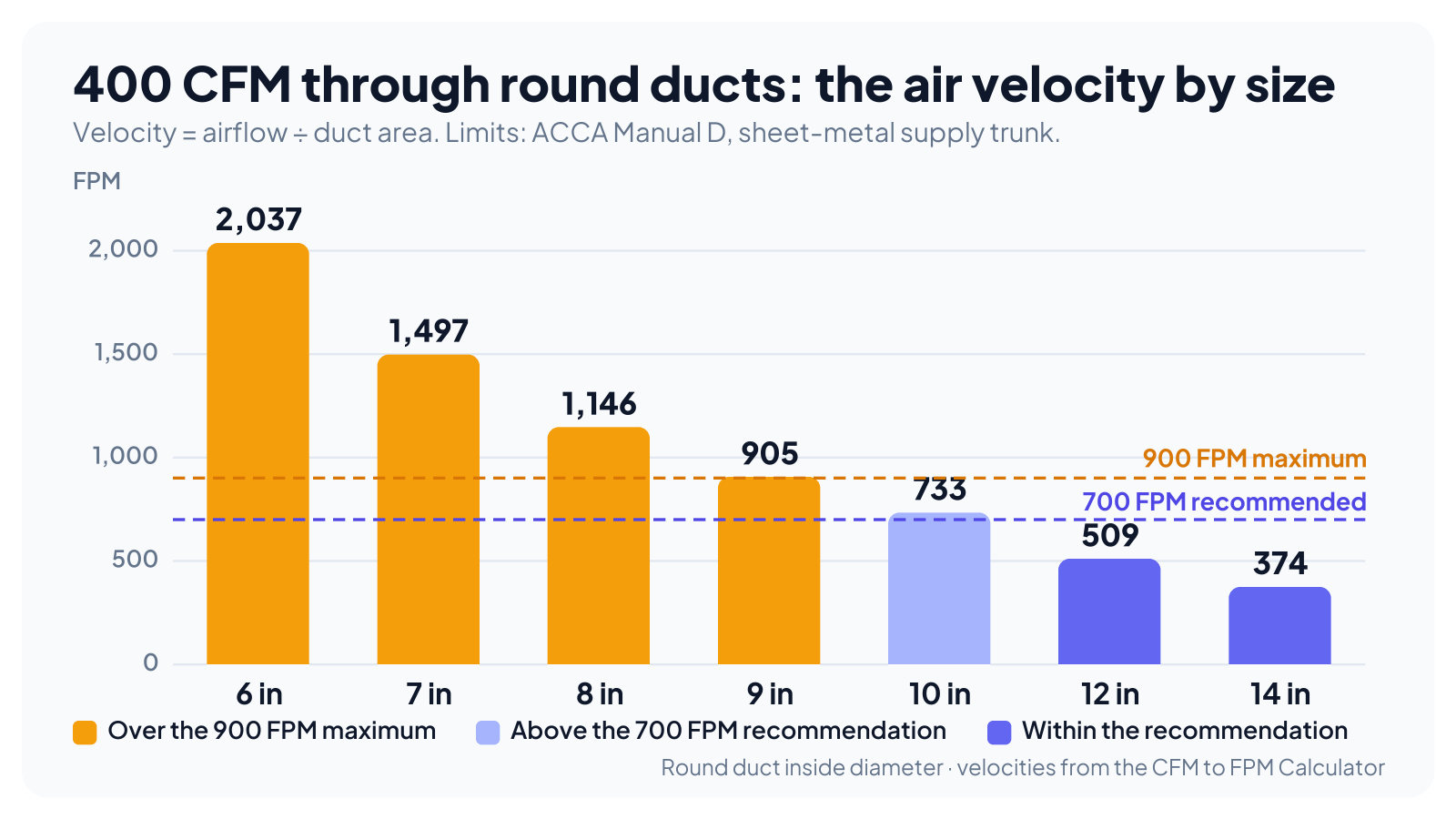
This CFM to FPM calculator divides the airflow by the duct's inside area: FPM = CFM ÷ area in square feet. 400 CFM through a 12 × 8 in duct (0.667 sq ft) moves at 600 FPM, and through an 8 in round duct (0.349 sq ft) at 1,146 FPM.
CFM to FPM Formula: Velocity = Airflow ÷ Duct Area
Air velocity in a duct is the airflow divided by the duct’s inside cross-section. Divide CFM by the area in square feet to get FPM, or multiply FPM by the area to get CFM. Dwyer’s pitot-tube manual states it the same way: flow in cubic feet per minute equals the duct’s cross-sectional area in square feet times the air velocity in feet per minute.
Round duct: area = π × diameter² ÷ 4
Rectangular duct: area = width × height
Flat oval duct: area = π × b² ÷ 4 + b × (a − b), where a is the long side and b the short side
Square inches to square feet: divide by 144
CFM to FPM Conversion Chart for Round Ducts
The same CFM gives a different velocity in every duct size, so a CFM to FPM chart needs the duct size. The table lists the inside area of common round ducts, the velocity of 100 CFM in each, and the airflow each one carries at 600, 700 and 900 FPM. The velocity scales with the airflow: twice the CFM in the same duct moves twice as fast.
| Round duct | Inside area | FPM at 100 CFM | CFM at 600 FPM | CFM at 700 FPM | CFM at 900 FPM |
|---|---|---|---|---|---|
| 4 in | 12.6 sq in | 1,146 | 52.4 | 61.1 | 78.5 |
| 5 in | 19.6 sq in | 733 | 81.8 | 95.4 | 123 |
| 6 in | 28.3 sq in | 509 | 118 | 137 | 177 |
| 7 in | 38.5 sq in | 374 | 160 | 187 | 241 |
| 8 in | 50.3 sq in | 286 | 209 | 244 | 314 |
| 9 in | 63.6 sq in | 226 | 265 | 309 | 398 |
| 10 in | 78.5 sq in | 183 | 327 | 382 | 491 |
| 12 in | 113.1 sq in | 127 | 471 | 550 | 707 |
| 14 in | 153.9 sq in | 93.5 | 641 | 748 | 962 |
| 16 in | 201.1 sq in | 71.6 | 838 | 977 | 1,257 |
| 18 in | 254.5 sq in | 56.6 | 1,060 | 1,237 | 1,590 |
| 20 in | 314.2 sq in | 45.8 | 1,309 | 1,527 | 1,963 |
Recommended Duct Velocity: Manual D Limits
ACCA Manual D, the residential duct design procedure recognized by ANSI and required by residential building codes, gives a recommended and a maximum velocity for each part of a home system. ACCA’s Manual D duct design checklist reprints the table, and lists air that is too noisy and drowns out conversation among the problems that wrong-sized ducts cause.
| Duct | Recommended, sheet metal | Recommended, flex | Maximum, sheet metal | Maximum, flex |
|---|---|---|---|---|
| Supply trunk | 700 FPM | 600 FPM | 900 FPM | 700 FPM |
| Supply branch | 600 FPM | 600 FPM | 900 FPM | 700 FPM |
| Return trunk | 600 FPM | 600 FPM | 700 FPM | 700 FPM |
| Return branch | 400 FPM | 400 FPM | 700 FPM | 700 FPM |
Registers and grilles have face-velocity limits of their own: a supply register is sized for throw, with a 700 FPM maximum; a return grille tops out at 500 FPM and a filter grille at 300 FPM.
How to Use the CFM to FPM Calculator
- Pick the duct shape
Choose round, rectangular or flat oval. If you already know the open area, such as a grille’s free area, choose Known area.
- Enter the inside size
Type the inside diameter, or the inside width and height, in inches, millimeters or centimeters.
- Enter the airflow or the velocity
Type the CFM and keep the picker on CFM to get the velocity in FPM. To go the other way, switch the picker to FPM and type the velocity to get the CFM. m³/h, L/s and m/s work too.
- Pick the duct for the Manual D check
Choose the part of the system, such as a sheet-metal supply trunk or a return grille, to see whether the speed is within Manual D’s limits.
- Read the result
The big number is the velocity or the airflow. Below it are the duct area, the velocity pressure and the smallest round duct that keeps the air at the recommended speed.
Working with water or steam instead of air? The lb/hr to GPM converter turns a mass flow into gallons per minute.
Worked Examples: CFM to FPM and FPM to CFM
- 400 CFM in a 12 × 8 in return trunk
The duct’s area is 12 × 8 = 96 sq in, or 0.667 sq ft. 400 CFM ÷ 0.667 sq ft = 600 FPM, exactly Manual D’s recommended speed for a return trunk.
- 400 CFM in an 8 in round supply trunk
An 8 in duct has 50.3 sq in, or 0.349 sq ft, so 400 CFM moves at 1,146 FPM, over the 900 FPM maximum for a sheet-metal supply trunk. A round duct of at least 10.2 in carries the same 400 CFM at the recommended 700 FPM.
- 700 FPM measured in a 10 in round duct
A 10 in duct has 78.5 sq in, or 0.545 sq ft. 700 FPM × 0.545 sq ft = 382 CFM.
- 500 FPM across a return grille with 0.5 sq ft of free area
500 FPM × 0.5 sq ft = 250 CFM. The face velocity sits exactly at the 500 FPM maximum for a return grille.
- 400 m³/h in a 200 mm round supply branch
400 m³/h is 235 CFM, and a 200 mm duct has 314.2 cm², or 0.338 sq ft, so the air moves at 696 FPM (3.54 m/s). That is above the 600 FPM recommended for a sheet-metal supply branch, but under its 900 FPM maximum.
Duct Velocity Pressure and Pitot-Tube Readings
A pitot tube and a manometer read velocity pressure, not velocity. Dwyer’s Series 160E manual converts it with air velocity = 1096.7 × √(Pv ÷ D), where Pv is the velocity pressure in inches of water and D is the air density, 0.075 lb per cubic foot for dry air. At that density the formula becomes FPM ≈ 4005 × √Pv, and the calculator runs it backward to show the velocity pressure at your velocity.
| Velocity | Velocity pressure | In pascals |
|---|---|---|
| 400 FPM | 0.01 in. w.c. | 2.49 Pa |
| 600 FPM | 0.022 in. w.c. | 5.59 Pa |
| 700 FPM | 0.031 in. w.c. | 7.61 Pa |
| 900 FPM | 0.051 in. w.c. | 12.6 Pa |
| 1,000 FPM | 0.062 in. w.c. | 15.5 Pa |
| 1,500 FPM | 0.14 in. w.c. | 34.9 Pa |
| 2,000 FPM | 0.249 in. w.c. | 62.1 Pa |
A single reading at the center of the duct runs high, because the air moves slower near the walls. For a quick check without a full traverse, Dwyer multiplies the center velocity by 0.9 and expects the result to be within about 5%.