Quick Answer
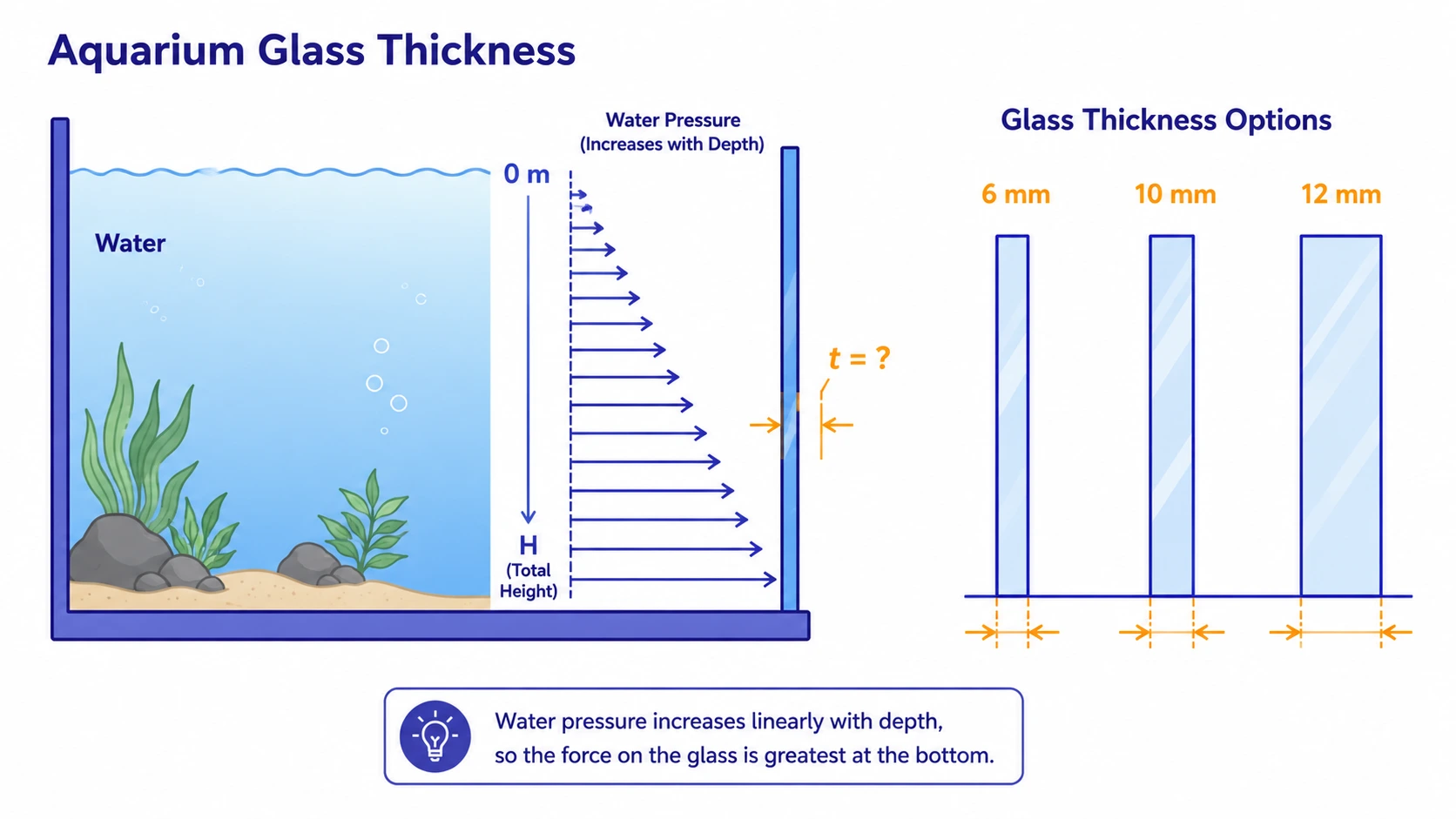
Aquarium glass thickness comes from plate theory: t = √(β × H³ × 0.00001 ÷ B), where B is the glass strength divided by a safety factor, and β is read from the pane's length-to-height ratio. Water height dominates — thickness rises with roughly H^1.5, so 30 cm to 60 cm of water multiplies the glass by 2.61, not 2. A 120 × 50 × 50 cm tank needs 10.02 mm, so a 12 mm pane, and holds 299 kg of water.
How to Use the Aquarium Glass Thickness Calculator
The fields start empty, so nothing is assumed about your build. Fill them in and the pane size, safety verdict and water weight appear as you type.
- Pick the material. Annealed float glass is the default and the usual DIY choice. Tempered glass and cast acrylic change the answer substantially.
- Enter length, height and width. Height means water height, and it is by far the most important number. Each field has its own unit picker, so a spec like “48 inches long, 500 mm deep” needs no hand conversion — switch a picker and the value already typed is converted rather than cleared.
- Or tap a quick-fill preset — 60×30×30 up to 150×50×60 cm — to load a common build and adjust from there.
- Leave the safety factor at 3.8 unless you have a reason. Raise it for rimless or commercial tanks; lowering it below 3.0 triggers a warning.
- Read the verdict, not just the number. The tool gives the calculated minimum thickness, rounds it up to the nearest pane you can actually buy, and then separately checks how far that pane will bow.
The Formula
Two calculations run, and they answer different questions. The first sizes the pane against breaking; the second checks how much it will visibly bow.
Deflection: δ = α × p × H⁴ ÷ (E × t³), where p = 0.00000981 × H
H is water height in mm, σ is the allowable stress and E the elastic modulus, both in N/mm².
β and α come from a six-row table indexed by the pane’s aspect ratio, with values interpolated between rows and held flat outside them. Those two coefficients are the only place the tank’s length enters the calculation at all.
| Aspect ratio (L ÷ H) | β (stress) | α (deflection) |
|---|---|---|
| 0.5 | 0.060 | 0.013 |
| 1.0 | 0.225 | 0.061 |
| 1.5 | 0.340 | 0.100 |
| 2.0 | 0.390 | 0.120 |
| 2.5 | 0.410 | 0.125 |
| 3.0 | 0.420 | 0.128 |
Worked Example: a 120 × 50 × 50 cm Tank
- Aspect ratio. 1,200 mm ÷ 500 mm = 2.4, which interpolates to β = 0.406 and α = 0.124.
- Allowable stress. Annealed glass is taken at σ = 19.2 N/mm²; divided by the 3.8 safety factor that is B = 5.05 N/mm².
- Thickness. √(0.406 × 500³ × 0.00001 ÷ 5.05) = 10.02 mm, which rounds up to a 12 mm pane — 11 mm is not a size you can buy.
- Deflection check. Water pressure at the base is 4.9 kPa. At 12 mm the pane bows 0.32 mm against a 5 mm limit, so the verdict is Safe.
- Volume and weight. 300 litres, 299 kg of water alone.
Water Height Decides Almost Everything
Height appears cubed inside a square root, so thickness scales roughly with H1.5. Doubling the water height from 30 cm to 60 cm does not double the glass — it multiplies the required thickness by 2.61, from 4.74 mm to 12.35 mm.
| Water height | Pressure at base | Calculated thickness | Pane to buy |
|---|---|---|---|
| 30 cm | 2.94 kPa | 4.7 mm | 5 mm |
| 40 cm | 3.92 kPa | 7.2 mm | 8 mm |
| 50 cm | 4.9 kPa | 9.8 mm | 10 mm |
| 60 cm | 5.89 kPa | 12.3 mm | 15 mm |
| 70 cm | 6.87 kPa | 14.8 mm | 15 mm |
| 80 cm | 7.85 kPa | 16.9 mm | 19 mm |
All six rows are a 100 cm long tank in annealed glass at a 3.8 safety factor. Past 60 cm of water the tool adds a warning telling you to have a glazier second-check the build, and that is the right instinct — the jump from a 10 mm pane to a 19 mm one is a different tank, a different price and a different stand.
Length Matters Far Less Than People Expect
Because length only enters through β, and β flattens out above an aspect ratio of about 3, stretching a tank stops changing the glass long before it stops changing the price:
| Length (H fixed at 50 cm) | Aspect ratio | β | Thickness | Pane to buy |
|---|---|---|---|---|
| 50 cm | 1.0 | 0.225 | 7.5 mm | 8 mm |
| 75 cm | 1.5 | 0.340 | 9.2 mm | 10 mm |
| 100 cm | 2.0 | 0.390 | 9.8 mm | 10 mm |
| 125 cm | 2.5 | 0.410 | 10.1 mm | 12 mm |
| 150 cm | 3.0 | 0.420 | 10.2 mm | 12 mm |
| 200 cm | 4.0 | 0.420 | 10.2 mm | 12 mm |
From 150 cm to 200 cm the required thickness does not move at all, because β is already pinned at its maximum. What does change is bowing across an unsupported span, which is why the tool warns above 150 cm to add eurobracing or a centre brace rather than simply buying thicker glass.
Annealed Glass vs Tempered vs Acrylic
Same 120 × 50 × 50 cm tank, same 3.8 safety factor, three materials:
| Material | σ (N/mm²) | E (N/mm²) | Thickness | Pane | Deflection at that pane |
|---|---|---|---|---|---|
| Annealed float glass | 19.2 | 69,000 | 10.0 mm | 12 mm | 0.32 mm |
| Tempered glass | 65.0 | 69,000 | 5.4 mm | 6 mm | 2.55 mm |
| Cast acrylic | 70.0 | 3,000 | 5.2 mm | 6 mm | 58.66 mm |
The last column is the one that matters and the one most thickness charts omit. Acrylic is as strong as tempered glass on paper — 70 against 65 N/mm² — so the stress formula asks for the same 6 mm. But acrylic’s elastic modulus is 23 times lower, and deflection divides by E. A 6 mm acrylic pane on this tank would bow nearly 59 mm. That is why the tool returns an unsafe verdict there, and why real acrylic tanks are built far thicker than a strength comparison alone suggests.
What the Safety Factor Is Actually Doing
The safety factor divides the glass’s strength before any sizing happens, which is why it moves the answer so directly:
| Safety factor | Allowable stress B | Thickness | Pane to buy |
|---|---|---|---|
| 2.5 | 7.68 N/mm² | 8.1 mm | 10 mm |
| 3.0 | 6.40 N/mm² | 8.9 mm | 10 mm |
| 3.8 (default) | 5.05 N/mm² | 10.0 mm | 12 mm |
| 5.0 | 3.84 N/mm² | 11.5 mm | 12 mm |
| 6.0 | 3.20 N/mm² | 12.6 mm | 15 mm |
The 19.2 N/mm² this tool starts from is already a cautious figure. Published normative values for annealed glass sit higher — DIN 18008-1 uses 36 N/mm² for as-cut annealed edges, and the same standard treats edge strength as 80% of surface strength, with well-executed cutting reaching 60 N/mm² or more in testing. Those figures and the edge-finishing factors behind them are set out in this review of the edge strength of annealed float glass. The practical lesson for a builder is that edges are where aquariums fail: a chipped or roughly cut edge throws away strength the calculation assumed you had.
Common DIY Build Sizes
The five quick-fill presets, all in annealed glass at a 3.8 safety factor:
| L × W × H (cm) | Volume | Calculated | Pane to buy | Deflection |
|---|---|---|---|---|
| 60 × 30 × 30 | 54 L | 4.6 mm | 5 mm | 0.33 mm |
| 80 × 35 × 40 | 112 L | 7.0 mm | 8 mm | 0.34 mm |
| 100 × 40 × 50 | 200 L | 9.8 mm | 10 mm | 0.53 mm |
| 120 × 50 × 50 | 300 L | 10.0 mm | 12 mm | 0.32 mm |
| 150 × 50 × 60 | 450 L | 13.2 mm | 15 mm | 0.41 mm |
If you are working the other way round — you know the tank you want to fill and need the litres — the aquarium volume calculator handles bow-front, corner and cylinder shapes as well as rectangles, and the general volume calculator covers anything else.