Quick Answer
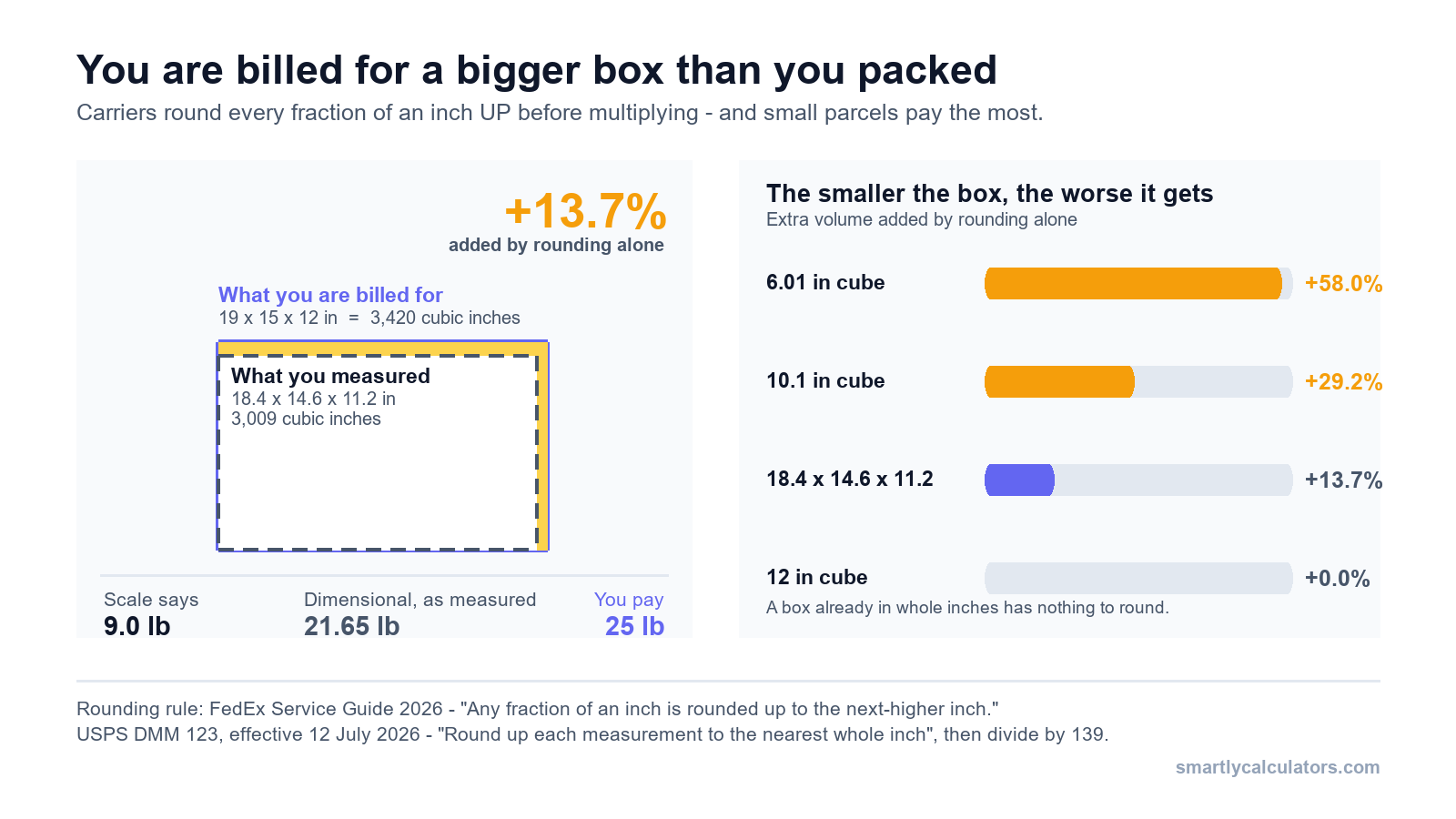
A chargeable weight calculator bills the greater of a parcel's actual weight and its dimensional weight, and every side is rounded up to the next whole inch before the three are multiplied and divided by 139. An 18.4 x 14.6 x 11.2 in box weighing 9.0 lb is billed as 19 x 15 x 12 in - 3,420 cubic inches - which is 25 lb.
Chargeable Weight Formula: Divisor, Rounding and the Greater-Of Rule
Chargeable weight is the greater of a parcel’s actual weight and its dimensional weight. Dimensional weight comes from the volume, but not from the volume you measured — every fraction of a dimension is rounded up first, and only then are the three sides multiplied.
Chargeable = max( actual weight, ⌈L⌉ × ⌈W⌉ × ⌈H⌉ ÷ divisor )The ceiling brackets are the part that costs money. For a U.S. parcel the divisor is 139 in³/lb and the result is rounded up again to the next whole pound. Four rules are in common use, and this calculator runs all four on the same box at once.
| Rule | Divisor | Bills in | Where it applies |
|---|---|---|---|
| U.S. parcel | 139 in³/lb | Pounds, rounded up | FedEx, UPS, USPS and DHL Express U.S. domestic |
| Express international | 5,000 cm³/kg | Kilograms | The metric form of the same rule |
| IATA air cargo | 6,000 cm³/kg | Kilograms | General air freight; 20% more generous |
| Sea LCL | 1 CBM = 1,000 kg | Revenue tonnes | Less-than-container-load ocean freight |
There is a second way to read the divisor that makes the whole rule obvious: it is a density threshold. Dimensional weight beats actual weight exactly when volume ÷ weight exceeds the divisor, so “139 in³/lb” is the same statement as “anything lighter than 12.43 lb per cubic foot”. In metric, 5,000 cm³/kg is 200 kg/m³. Pack denser than that and the scale wins; pack lighter and you pay for air. The calculator prints your box’s own in³/lb next to the limit so the comparison is a single glance.
Why Every Fraction of an Inch Is Rounded Up
FedEx changed this on 18 August 2025 and UPS matched it the same day: a fraction of an inch is no longer dropped, it is rounded up. The FedEx Service Guide 2026 puts it in one line — “Any fraction of an inch is rounded up to the next-higher inch.” USPS followed on 12 July 2026, and DMM 123 spells out the whole order of operations: round up each measurement, multiply, and only then test the result against the threshold.
The important thing is that this is not a flat percentage. The swell depends on how big the box is, because a whole inch is a bigger fraction of a small side than of a large one.
| Measured box | Actual volume | Billed volume | Swell |
|---|---|---|---|
| 12 × 12 × 12 in | 1,728 in³ | 1,728 in³ | 0.0% |
| 18.4 × 14.6 × 11.2 in | 3,009 in³ | 3,420 in³ | 13.7% |
| 9.6 × 13.2 × 17.1 in | 2,167 in³ | 2,520 in³ | 16.3% |
| 11.1 × 9.2 × 7.3 in | 745 in³ | 960 in³ | 28.8% |
| 10.1 × 10.1 × 10.1 in | 1,030 in³ | 1,331 in³ | 29.2% |
Worst case is a box barely over a whole inch on every side: a 6.01″ cube bills as a 7″ cube, which is 58.0% more volume. A 10.01″ cube gains 32.7% and a 20.01″ cube 15.6%.
One widely repeated figure is simply wrong. Several trade outlets describe the 9.6 × 13.2 × 17.1 in example as adding “nearly 20%” of volume. Run their own numbers: 2,167 in³ becomes 2,520 in³, which is 16.3%. The calculator shows the swell for your actual box rather than a rule of thumb.
The Carrier Divisor Table Is Mostly a Units Artifact
Almost every chargeable weight calculator publishes a table of “carrier divisors” — FedEx 139, DHL 5000, IATA 6000, USPS 166 — as though those were four different policies. Convert them into one unit system and most of the differences disappear.
| Written as | Same rule in the other system | Gap |
|---|---|---|
| 139 in³/lb | 5,021.7 cm³/kg | 0.43% from 5,000 |
| 5,000 cm³/kg | 138.40 in³/lb | 0.43% from 139 |
| 6,000 cm³/kg | 166.08 in³/lb | this is the old USPS 166 |
So 139 in³/lb and 5,000 cm³/kg are one rule, written twice, 0.43% apart. And the 166 that USPS used before July 2026 was never a USPS invention — it is IATA’s 6,000 cm³/kg expressed in imperial units, which is why the switch to 139 is described as an alignment rather than a new policy.
The proof is DHL. Every calculator on the web lists DHL Express under “5000”. DHL’s own Express U.S. Service & Rate Guide for 2026 instructs you to “multiply the length by height by width in inches, then divide the total sum by 139” — the same carrier, the same service, two unit systems, two apparently different divisors.
What genuinely differs is the step between 5,000 and 6,000: IATA’s air-cargo divisor is exactly 20% more generous than the express one. On a light, bulky shipment that is a fifth off the billable weight, and it is the only gap in the table worth negotiating over.
How to Use the Chargeable Weight Calculator
- Pick your units
Choose inches and pounds or centimetres and kilograms. Anything already typed is converted, so the box you described stays the same box.
- Measure the packed box and enter all three sides
Measure the outside at the longest point on each axis, bulges and tape included. Enter the real fractions — 18.4, not 18. The fractions are the whole point of this tool. If the item is an odd shape, work out the smallest rectangular box it fits inside first; the volume calculator will do that arithmetic for you.
- Enter the weight on the scale
Weigh the box packed and sealed. Without this the tool can only show the dimensional side, and a carrier bills the greater of the two.
- Choose the rule
U.S. parcel for FedEx, UPS or USPS domestic; express international for a cross-border courier; IATA for air cargo; sea LCL for ocean freight. The comparison strip shows all four on your box at once regardless of which one is selected.
- Read the trim table
If any side has a fraction, the tool lists what each side would save if you shaved it down to the whole unit below, ranked by weight saved and then by how little you have to trim.
Worked Examples: One Box Under Four Rules
A 16 × 12 × 10 in carton weighing 8.0 lb (3.63 kg) is 1,920 in³, or 31,463 cm³. Every side is already a whole inch, so nothing rounds and the swell is 0.0% — this example isolates the divisor from the rounding.
| Rule | Dimensional weight | Chargeable | Which wins |
|---|---|---|---|
| U.S. parcel, 139 in³/lb | 13.81 lb | 14 lb | Dimensional |
| Express international, 5,000 cm³/kg | 6.29 kg | 6.29 kg | Dimensional |
| IATA air cargo, 6,000 cm³/kg | 5.24 kg | 5.24 kg | Dimensional |
| FedEx International Deferred Freight, 166 in³/lb | 11.57 lb | 12 lb | Dimensional |
| Sea LCL, 1 CBM = 1,000 kg | 31.5 kg | 31.5 kg | Volume |
Sea freight is a different rule, not a different divisor: 0.0315 CBM priced as a revenue tonne is 31.5 kg, five times the express figure for the identical box.
Now the same exercise with fractions. The default box in the calculator is 18.4 × 14.6 × 11.2 in at 9.0 lb. Measured, that is 3,009 in³, or 21.65 lb at 139 — but the billed box is 19 × 15 × 12 in, which is 3,420 in³ and 25 lb. The scale reading of 9.0 lb never enters the bill at all. Rounding alone added 3.35 lb of billable weight before any divisor was involved.
Which Side to Trim to Drop a Pound
Because rounding works per dimension, bringing one side down to the whole unit below removes an entire inch of billed depth on that axis. The volume that disappears is one inch multiplied by the other two rounded sides — which means the biggest saving comes from trimming the smallest side, since its two companions are then the two largest. That is counterintuitive enough that no consumer calculator offers the advice.
| Trim | By | Billed volume saved | Weight saved at 139 |
|---|---|---|---|
| Height 11.2″ → 11″ | 0.2″ | 285 in³ | 2 lb |
| Width 14.6″ → 14″ | 0.6″ | 228 in³ | 2 lb |
| Length 18.4″ → 18″ | 0.4″ | 180 in³ | 1 lb |
Height is the smallest side of this box, and it also needs the least trimming — 0.2″ for two pounds. The calculator ranks the three by weight saved, then by the smallest trim required.
In practice that means a slightly overfilled carton is worth repacking, and a box that measures 10.1″ on a side is worth 0.1″ of compression. It also means the standard advice to “use a smaller box” is too vague: on a fractional box, the side to attack is rarely the long one.
What Each Carrier Actually Does
The three carriers that all divide by 139 do not agree on when to apply the rule at all.
That floor produces a cliff, because the threshold is tested on the rounded volume. A 12 × 12 × 12 in parcel weighing 8.0 lb is exactly 1,728 in³, does not exceed the floor, and is billed 8 lb by USPS. Add a tenth of an inch to one side and it rounds to 13 × 12 × 12 in, which is 1,872 in³ and 14 lb. The parcel grew 0.8% in real volume and 75% in billed weight.
FedEx keeps one exception to its own divisor: International Deferred Freight still divides by 166 rather than 139, which is worth checking if that is the service on your rate sheet. And UPS should be treated with slightly more caution here than the other two. UPS does not serve its rate and service guide to automated readers, so the 139 divisor and the round-up rule are grouped with FedEx on secondary reporting rather than read from the UPS document directly. Confirm it against the copy your account manager sends you before you build it into a quote.
A negotiated divisor overrides all of this. If your contract says 166 or 194 in³/lb, enter it in the Advanced panel — and note that a “166” concession is IATA’s standard air-cargo rate, not a bespoke favour.
Where This Estimate Stops: Minimums, Oversize and Re-measurement
Chargeable weight is the figure the rate table is read against, not the invoice. Several rules in the FedEx Service Guide 2026 override or add to it, and none of them live in a divisor calculator.
| Trigger | What it does to the bill |
|---|---|
| Non-standard packaging, or cubic volume over 10,368 in³ | Rated on the greater of actual or dimensional weight, subject to a 40 lb minimum billable weight |
| Oversize package | 90 lb minimum billable weight, plus an oversize charge |
| Express freight handling unit | 151 lb minimum billable weight per unit, whatever the scale says |
| Unauthorized package | Over 108 in on the longest side, over 165 in in length and girth, or over 150 lb actual |
Length and girth is the length plus twice the height plus twice the width — and any fraction of an inch in that measurement is rounded up as well.
A minimum cuts the other way from the divisor, and that matters for the trim table above. If a 40 lb floor applies, shaving two pounds off a 25 lb dimensional weight saves nothing at all: you are already paying the minimum. Work out which floor your service imposes before you repack anything.
The other thing a calculator cannot model is re-measurement. The same guide notes that a package’s shape and dimensions may change in transit, and that FedEx may adjust the charges accordingly at any time. Carriers re-measure with automated dimensioners on the belt, so the number worth entering here is the packed, sealed, slightly bulging box — not the flat carton’s printed size. A parcel measured at 11.9 in on the bench and 12.1 in on the belt crosses a whole inch, and with it the USPS floor.